
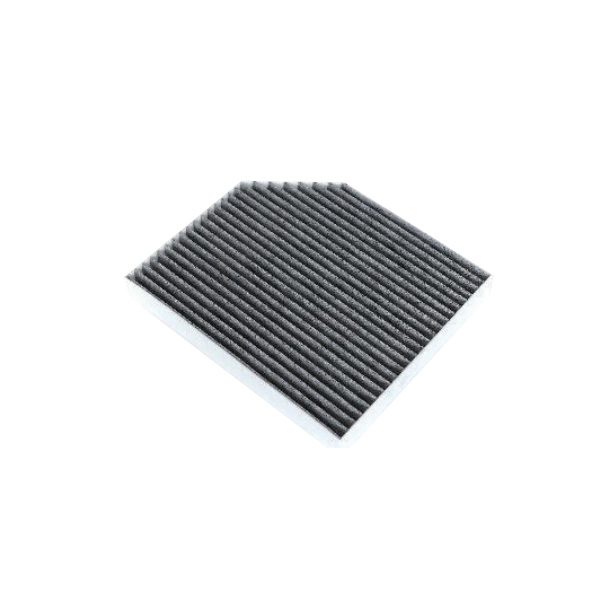
Zanxis automotive cabin air filters combine high-efficiency HEPA media with high-iodine coconut-shell activated carbon to capture PM2.5, dust, pollen and adsorb ammonia, sulfides and exhaust VOCs. They are designed for passenger cars, buses, heavy trucks and construction machinery, and are available as full-vehicle OEM custom solutions. This page is written for quality and purchasing engineers who verify filter performance through samples and test reports before approval.
| Item | Detail |
|---|---|
| Product name | Automotive cabin air filter / automotive air filter |
| Core construction | Dual-effect composite: high-precision HEPA filter media + high-iodine coconut-shell granular activated carbon |
| Core purification performance | High-efficiency interception of PM2.5 particles and dust + deep targeted adsorption of ammonia, sulfides and exhaust VOCs |
| Physical and flow characteristics | Good air flow characteristics, low operating resistance, very high dust holding capacity and service life |
| Main applications | Air conditioning and ventilation systems of passenger cars (sedans/SUVs/MPVs, etc.), commercial buses, heavy trucks and construction machinery |
| Custom sizes | 100% support for full-vehicle OEM/ODM flexible customization. Any length, width, thickness and pleat count can be customized according to the air duct requirements of different original equipment vehicles. |
| Quality certification system | Company operates a 50,000 m² plant, strictly implements the IATF16949 automotive quality management system, and ensures automotive-grade factory quality with support from a national-level CNAS testing center. |
Before a cabin filter is approved for a vehicle platform, several parameters should be confirmed against the original equipment specification. For the Zanxis filter, the primary performance values to verify are filtration efficiency (reported as ≥95% for PM2.5 and ≥99% for PM10), dust holding capacity, and initial resistance. These figures are not taken on trust: they are measured in the company’s CNAS-accredited laboratory and documented in test reports that can be supplied with samples.
Customization parameters also require sign-off: exact length, width, thickness and pleat count must match the vehicle’s air duct geometry. Because Zanxis supports 100% OEM/ODM customization, these dimensions are not fixed catalogue numbers but are defined per project. The company has developed more than 1,000 filtration solutions and can produce samples for validation within 7–10 working days for special vehicle models.
Quality system compliance is another checkpoint. Zanxis obtained IATF16949 certification in 2024 and also holds ISO 9001, ISO 14001 and ISO 45001 certificates. Products meet REACH and RoHS requirements, and compliance documentation is available for export markets. Confirming these certificates early avoids surprises during supplier qualification.
For engineers who need to validate performance before production, Zanxis recommends the following sequence:
The Zanxis cabin filter is built as a dual-effect composite: a high-precision HEPA filter layer for particle capture and a layer of high-iodine coconut-shell granular activated carbon for odour and gas adsorption. This construction targets both particulate matter (PM2.5 and dust) and gaseous pollutants such as ammonia, sulfides and exhaust VOCs, which are common in heavy traffic and urban environments. The pleated design provides low operating resistance, helping to maintain HVAC airflow and reduce load on the blower motor.
Thanks to the high dust holding capacity, the filter maintains performance over a longer service interval. Under normal use, Zanxis recommends replacement every 10,000–15,000 km or 6–12 months, whichever comes first; in dusty or heavily polluted areas, the interval should be shortened. The filter is intended for passenger cars (sedans, SUVs, MPVs), commercial buses, heavy trucks and construction machinery. Because the product is custom-made to the vehicle’s air duct, installation follows the original equipment procedure without modification.
Zanxis operates a 50,000 m² manufacturing plant in Zhongshan, Guangdong, China, including six cleanrooms totalling 20,000 m². The company’s in-house laboratory is accredited by CNAS (China National Accreditation Service for Conformity Assessment) and issues test reports for filtration efficiency, dust holding capacity and resistance. These reports are recognised internationally and can be provided to customers for verification.
Quality management follows IATF16949 (certified in 2024), ISO 9001, ISO 14001 and ISO 45001. Every production batch is controlled through incoming inspection (IQC), in-process inspection (IPQC) and outgoing inspection (OQC). Key tests include filtration efficiency, dust holding capacity, resistance, tensile strength and VOC release. With more than 20 years of filtration R&D and manufacturing experience, Zanxis has supplied OEM and ODM customers in Europe, the US, Japan and Korea, and supports customization of size, structure, media grade, frame material, logo and packaging.
To evaluate the Zanxis automotive cabin air filter for your application, please contact us with the following details:
Our engineering team will review your requirements and respond with a sample proposal and available test reports. Contact Zanxis to start the verification process.
Yes. Zanxis has a CNAS-accredited in-house laboratory that issues reports for filtration efficiency, dust holding capacity and resistance. These reports can be supplied with samples and production batches. The data reflects the specific media and construction used in your order.
For standard specifications, samples are available from stock and can be dispatched quickly. For custom developments, Zanxis typically completes sample fabrication within 7–10 working days after drawing confirmation. Validation time then depends on your installation and testing schedule.
The Zanxis cabin filter achieves ≥95% filtration efficiency for PM2.5 particles and ≥99% for PM10, as measured in the company’s CNAS-accredited laboratory. Efficiency can be customized by selecting different media grades. Always confirm the target efficiency for your vehicle platform during sample approval.
Yes. Zanxis supports 100% OEM/ODM customization for length, width, thickness and pleat count, based on your air duct drawing or sample. The company has developed over 1,000 filtration solutions and can adapt the filter to most passenger cars, buses, trucks and construction machinery.
Standard specifications typically have an MOQ of 1,000–2,000 pieces, while custom designs generally start at 5,000 pieces due to tooling. Lead time is 15–25 days for standard items and 30–45 days for custom items after sample approval. Monthly capacity reaches several million pieces.
Under normal driving conditions, Zanxis recommends replacement every 10,000–15,000 km or 6–12 months. In dusty or highly polluted environments, the interval should be shortened. The high dust holding capacity helps maintain performance between changes.
Yes. Zanxis holds IATF16949, ISO 9001, ISO 14001 and ISO 45001 certifications, and products comply with REACH and RoHS. A complete compliance file can be provided to support customs and customer audits. Please specify your destination market when requesting documents.
Please <a href="/en/contact">contact our team</a> with your vehicle model, dimensions or drawing, target airflow, operating conditions and estimated quantity. We will respond with a sample proposal, test reports and a quotation. Standard samples are free (freight collect); custom samples carry a refundable tooling fee.