
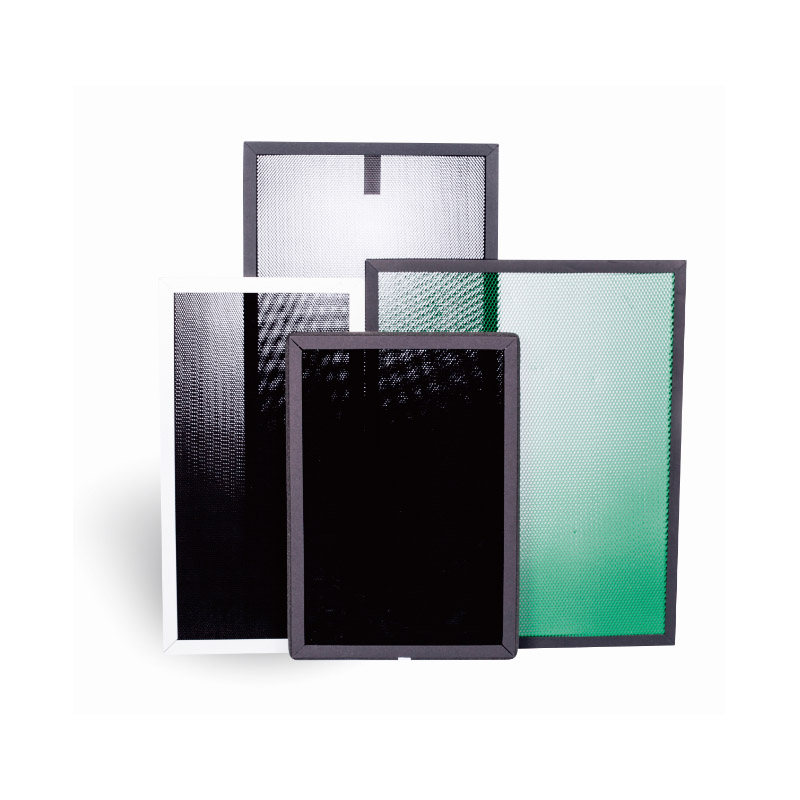
The Zanxis ozone removal filter is an aluminum honeycomb filter coated with a proprietary catalyst that decomposes ozone into oxygen. It is designed to reduce ozone emissions from high-voltage electrostatic air purifiers, large laser printers, commercial copiers, ozone disinfection equipment, and medical device exhausts. This filter is used by OEMs and HVAC engineers who need to meet indoor ozone limits such as China's 0.16 mg/m³ standard and UL 867 (≤0.1 mg/m³). Zanxis manufactures it in Zhongshan, Guangdong, with full size customization and CNAS-accredited test reports available for verification.
| Item | Detail |
|---|---|
| Product name | Ozone Removal Filter / Ozone Decomposition Catalytic Filter |
| Core structure and material | Aluminum honeycomb substrate with a self-developed ozone-specific catalyst coating |
| Patent backing | National invention patent, patent number: ZL200710026260.6 |
| Ozone treatment standard | Treated indoor ozone concentration below the national standard of 0.16 mg/m³, meeting UL 867 (≤0.1 mg/m³) testing requirements |
| Main application end products | High-voltage electrostatic air purifiers, large laser printers, commercial copiers, ozone disinfection machine exhaust treatment, medical device exhaust ports |
| Frame and size customization | 100% customized to customer equipment dimensions. Aluminum honeycomb cut to various thickness specifications; optional aluminum alloy frame and sponge/EVA sealing strips for installation airtightness |
| Quality system certification | Manufactured in a 50,000 m² clean plant with a national-level CNAS testing center. The company strictly implements ISO 9001/14001 and IATF 16949 international quality management systems |
Before selecting this filter, confirm the ozone concentration at the inlet, the airflow rate, and the allowable pressure drop for your system. The filter's ozone removal performance depends on contact time, so the honeycomb thickness and cell density must match your airflow. Also verify the maximum ozone concentration the filter will encounter; while the catalyst is designed for continuous duty, extremely high concentrations may require a larger filter or a different catalyst loading. Confirm the required outlet ozone limit: China's national standard for indoor air is 0.16 mg/m³, while UL 867 requires ≤0.1 mg/m³. Zanxis can provide test reports showing performance against these limits. Finally, confirm the physical dimensions and mounting method, as the filter is custom-cut and can be supplied with an aluminum frame and sealing strips to ensure a tight fit.
Zanxis recommends a structured sample validation process to ensure the filter meets your application requirements. The following steps outline the typical workflow:
The Zanxis ozone removal filter uses an aluminum honeycomb substrate coated with a proprietary catalyst. The honeycomb structure provides a high surface area with low airflow resistance, allowing efficient ozone decomposition at typical HVAC face velocities. The catalyst converts ozone (O₃) into oxygen (O₂) through a catalytic reaction without being consumed, giving the filter a long service life under normal conditions.
The filter is available in various thicknesses and cell densities to match different airflow and pressure drop requirements. It can be supplied as a bare honeycomb core or with an aluminum alloy frame and sponge/EVA sealing strips for easy installation and airtight sealing. Zanxis customizes the outer dimensions to fit your equipment, ensuring a drop-in replacement or OEM integration.
Typical applications include high-voltage electrostatic air purifiers, where ozone is generated as a byproduct of the ionization process; large laser printers and commercial copiers, which produce ozone during operation; ozone disinfection machines, where residual ozone in the exhaust must be removed; and medical device exhaust ports, where ozone may be present. The filter is also suitable for commercial air handling units and ventilation systems that require ozone removal. Zanxis recommends replacing the filter when ozone removal efficiency drops below the required level or when pressure drop exceeds the system limit; under typical conditions, replace every 12–18 months, but actual life depends on ozone concentration, airflow, and environmental conditions.
Zanxis operates a CNAS-accredited laboratory that can issue test reports for filter efficiency, dust holding capacity, and airflow resistance. These reports provide verifiable data for your qualification process. The company's quality management system is certified to ISO 9001, ISO 14001, and ISO 45001, and in 2024 it obtained IATF 16949 certification for automotive quality management. Products comply with REACH and RoHS environmental regulations, and compliance documents are available upon request.
Manufacturing takes place in a 50,000 m² facility with six clean rooms totaling 20,000 m². Multiple automated production lines support a monthly capacity of several million units. Quality control covers incoming materials (IQC), in-process inspection (IPQC), and outgoing inspection (OQC) to ensure batch consistency. With over 20 years of experience in filtration, Zanxis has developed more than 1,000 filtration solutions and exports to Europe, the United States, Japan, and South Korea. The company supports OEM/ODM projects, customizing size, structure, filter media grade, frame material, logo, and packaging.
To request samples or test reports for the Zanxis ozone removal filter, please provide the following details: your device or vehicle model, required dimensions or a drawing, airflow rate or water flow (if applicable), operating conditions (ozone concentration, temperature, humidity), and estimated quantity. This information helps Zanxis recommend the most suitable configuration and prepare an accurate quote. Contact us through our contact page to start the conversation. Our team will respond with sample availability, lead times, and pricing.
Yes. Zanxis can provide CNAS-accredited test reports covering filter efficiency, dust holding capacity, and airflow resistance. These reports are generated by our own laboratory and can be used to verify performance against standards such as UL 867. Please contact us with your specific requirements.
For custom samples, the production lead time is typically 10–15 days. After you receive the samples, bench testing and approval depend on your internal process; we can support with test protocols if needed. Standard sizes may be available from stock for faster delivery.
Under standard test conditions (0.1 ppm ozone concentration, 1.0 m/s face velocity), the ozone removal efficiency can reach over 95%. However, actual performance depends on factors such as contact time, honeycomb thickness, and airflow. We recommend validating with a sample in your specific application.
Yes, we offer 100% customization based on your equipment dimensions. We can cut the aluminum honeycomb to various thicknesses and provide optional aluminum alloy frames and sponge/EVA sealing strips to ensure airtight installation. Please provide a drawing or detailed dimensions for a precise quote.
The MOQ for standard specifications is typically 500–1,000 pieces. For custom sizes and configurations, the MOQ is generally 1,000 pieces or more, depending on complexity. Please contact our sales team with your requirements for an exact MOQ.
Under typical conditions, the filter can last 12–18 months. However, replacement frequency depends on ozone concentration, airflow, temperature, and humidity. We recommend monitoring performance and replacing when efficiency drops below your required level or when pressure drop exceeds system limits.
Yes, we welcome sample requests for performance verification. Standard sizes may be provided free of charge (freight collect), while custom samples may incur a fee that can be credited against a bulk order. Please provide your specifications so we can prepare the right sample.
For standard stock items, lead time is 7–10 days. For OEM/ODM custom orders, sample development takes about 10–15 days, and mass production typically requires 25–35 days after sample approval. We can discuss scheduled deliveries for long-term contracts.