
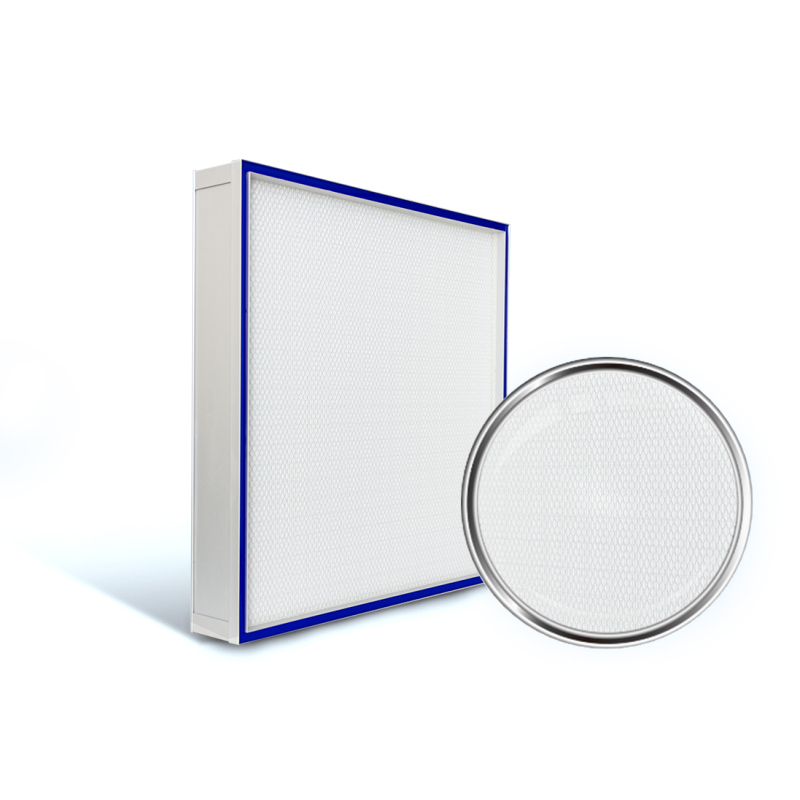
The Zanxis gel seal HEPA & ULPA filter is a high-efficiency pleated panel filter with a polyurethane gel seal, built for cleanrooms and equipment that cannot tolerate bypass leakage. It removes particles down to the MPPS range at H12, H13, H14, or U15 efficiency, using high-throughput, moisture-resistant ultra-fine glass fibre media in an anodised aluminium frame. It is supplied in top-gel-seal and side-gel-seal formats for semiconductor wafer fabs, GMP pharmaceutical suites, hospital operating rooms, FFU units, and high-spec paint lines. If you are qualifying a filter for an audit, the first step is agreeing which values on the table below you will verify, and how.
| Item | Detail |
|---|---|
| Product name | High-efficiency pleated panel filter (gel seal type) / Gel Seal HEPA & ULPA Filter |
| Filter class (EN 1822) | H12 / H13 / H14 (HEPA) / U15 (ULPA) |
| Core filter media | High-throughput, water- and moisture-resistant ultra-fine glass fibre |
| Frame and seal material | Anodised aluminium profile + polyurethane gel sealant |
| Mounting format | Top gel seal / side gel seal |
| Core applications | Semiconductor wafer fab cleanrooms, biopharma GMP workshops, class 100 hospital operating rooms, FFU purification equipment, high-standard coating lines |
| Standard sizes and rated airflow (W × H × D) | Side gel seal, 50 mm thick: 610×610×50 mm (1,000 m³/h); 1170×570×50 mm (1,800 m³/h). Top gel seal, 70 mm thick: 610×610×70 mm (750 m³/h); 1170×570×70 mm (1,300 m³/h). Maximum supported high-airflow specification: 3,600 m³/h |
| Customisation (OEM/ODM) | 50,000 m² plant and a CNAS-accredited testing centre; ISO and IATF 16949 certified. Non-standard dimensions, gel-channel widths, and airflow requirements supported |
Before a purchase order, a QA engineer usually wants four numbers pinned down. First, the efficiency class and the particle size it refers to: H13 and H14 are stated against 0.3 µm in our documentation, and U15 is a ULPA class, so the test basis should be written into the specification, not assumed. Second, the rated airflow at which that efficiency is declared — the standard sizes above are rated at 1,000, 1,800, 750, and 1,300 m³/h respectively, and a filter run well above its rated airflow will not hold the same resistance or service life. Third, initial resistance at that airflow, which sets the fan or FFU duty. Fourth, the gel channel dimensions and frame depth, because a 50 mm side-seal filter and a 70 mm top-seal filter are not interchangeable in the same housing.
It is also worth confirming what the filter is not asked to do. The gel seal controls bypass at the frame-to-housing interface; it does not replace correct housing alignment or a clean knife edge. Where a project specifies a maximum final resistance, agree that figure with us at quotation stage so the replacement trigger is unambiguous.
The filter uses ultra-fine glass fibre media selected for high throughput and resistance to moisture, pleated into an anodised aluminium profile frame. The seal is a polyurethane gel — a firm, elastic bead that seats into the mating knife-edge channel of the housing. Two formats are offered: side gel seal in 50 mm frame depth, and top gel seal in 70 mm depth. The side-seal 610×610×50 mm unit is rated at 1,000 m³/h and the 1170×570×50 mm at 1,800 m³/h; the top-seal 610×610×70 mm is rated at 750 m³/h and the 1170×570×70 mm at 1,300 m³/h. High-airflow specifications up to 3,600 m³/h are supported.
Typical duty is terminal filtration in semiconductor wafer fabrication cleanrooms, biopharmaceutical GMP workshops, class 100 hospital operating rooms, FFU purification equipment, and high-standard coating lines. In each case the filter is the last stage, so upstream pre-filtration matters: coarse and medium stages protect the HEPA or ULPA element and extend the interval between changes. When replacing, seat the new frame squarely into the gel channel and confirm the gel is continuous around the perimeter before restoring airflow. Do not clean and reuse the media.
Zanxis operates its own laboratory accredited by CNAS (China National Accreditation Service for Conformity Assessment), which issues reports covering filtration efficiency, dust holding capacity, and resistance. Those three values are the ones most often requested at tender stage, and they can be supplied against the specific unit number.
Quality control runs through the whole order: incoming inspection of media and frame material (IQC), in-process checks during pleating, sealing, and assembly (IPQC), and outgoing inspection before packing (OQC). The company holds ISO 9001, ISO 14001, and ISO 45001 certification, and obtained IATF 16949 automotive quality management certification in 2024. Products meet REACH and RoHS requirements, and compliance documents are available on request.
Manufacturing takes place on a 50,000 m² site in Zhongshan, Guangdong, China, including six cleanrooms totalling 20,000 m², where final assembly of high-efficiency filters is carried out. With more than 20 years of filter development and manufacturing experience and over 1,000 filtration solutions developed, the company exports to Europe, the United States, Japan, and South Korea, and supports OEM/ODM customisation of dimensions, structure, media class, frame material, logo, and packaging.
To quote accurately and to prepare the right sample, we need five pieces of information: the device or FFU/housing model, the size or a drawing (including frame depth and gel channel), the airflow you will run at, the operating conditions (temperature, humidity, upstream filtration), and the quantity for the trial and for series supply. Send these through the contact page and we will confirm the class, the test basis, and the sample and production schedule against your verification sheet.
Yes. Our own laboratory is CNAS-accredited and issues reports covering filtration efficiency, dust holding capacity, and resistance. Each filter carries a unique number that links it to its production batch and test data, so the report matches the unit supplied. Tell us which class and airflow you need reported.
Samples are typically ready within 7–10 days, and validation time on your side depends on your test bench and sheet. We recommend measuring frame depth and gel channel width first, then running efficiency and resistance at your declared airflow. Send the results with the sample number if anything falls outside your limits.
Confirm four values: the efficiency class and the particle size basis it is stated against, the rated airflow at which that class is declared, initial resistance at that airflow, and the frame depth and gel channel dimensions. For reference, standard sizes are rated at 750, 1,000, 1,300, and 1,800 m³/h, with high-airflow specifications up to 3,600 m³/h supported.
Yes. We support OEM/ODM customisation of non-standard dimensions, gel channel width, and airflow requirement, as well as frame material, media class, logo, and packaging. Top gel seal and side gel seal formats are both available. A drawing or housing measurement is the most useful starting point.
Standard sizes start from small trial quantities and scale with the order; custom sizes are agreed case by case. Lead time is confirmed at quotation once size, class, and quantity are fixed. Samples for validation are typically available within 7–10 days, so a trial can run before the series order is released.
Replacement is driven by resistance, not by the calendar. Agree a final resistance limit at quotation stage and change the filter when that limit is reached, since upstream pre-filtration and operating hours determine how quickly it occurs. We do not publish a fixed service life because it depends on your installation.
Yes. Products meet REACH and RoHS requirements and compliance documents can be provided. The company holds ISO 9001, ISO 14001, and ISO 45001 certification, and obtained IATF 16949 certification in 2024. State which documents your audit requires when you enquire.
Send the device or housing model, size or drawing, airflow, operating conditions, and quantity through our <a href="/en/contact">contact page</a>. With those details we can confirm the class, the test basis, and the sample and production schedule. We will reply with a quotation and a proposed verification sheet.