
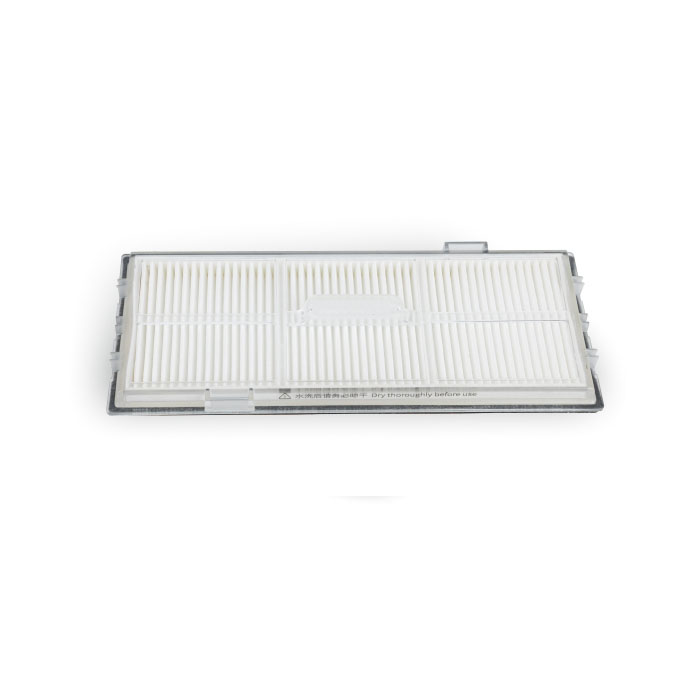
Zanxis washable dust box filters are removable filter elements for robot vacuums and handheld vacuums, built with PTFE membrane or composite PP meltblown media to capture PM2.5, fine dust, dust mites, pollen, and pet dander. They are designed for vacuum makers and aftermarket brands that need low-resistance filtration, repeatable washing performance, and dimensions matched to a specific dust box. Each filter is customised to the device, and Zanxis supports the validation process with samples and CNAS-accredited laboratory reports.
| Item | Detail |
|---|---|
| Product name | Robot vacuum / handheld vacuum filter |
| Core filtration material | High-precision PTFE (polytetrafluoroethylene microporous membrane) / composite PP (polypropylene meltblown) and other moisture-resistant, antibacterial media |
| Core purification function | Strong interception of PM2.5, fine dust, dust mites, pollen and pet dander inside the vacuum, preventing secondary exhaust pollution |
| Physical fluid characteristics | High-porosity breathable design with very low operating resistance; does not reduce motor suction and supports battery runtime |
| Main end applications | Smart robot vacuums, handheld cordless vacuums, mattress mite-removal devices, car mini vacuums, wet-dry floor cleaners |
| Frame and size customisation | 100% customised to the dust box dimensions; eco-friendly injection-moulded frame, edge sealing treatment; scalable OEM production for washable PTFE-coated versions |
| Company certification system | 50,000 m² modern production base and CNAS-accredited testing centre; ISO 9001, ISO 14001 and IATF 16949 quality management systems |
Before a washable filter is approved for a vacuum platform, four values should be fixed against the device and the intended use. First, filtration efficiency for the target particle range (PM2.5, fine dust, dust mites, pollen, pet dander) should be stated on a CNAS-accredited report, not only on a data sheet. Second, initial resistance at the device's operating airflow should be low enough that motor suction and battery runtime are not measurably reduced. Third, wash-cycle retention should be verified: Zanxis washable filters are tested to maintain more than 90% of initial filtration efficiency after more than 50 correct washes. Fourth, fit and sealing should be confirmed on the actual dust box, because a filter that is slightly undersized allows dust to bypass the media and foul the exhaust path.
All four values are product-specific and should be confirmed with samples and reports for the exact model, rather than transferred from another filter. Where a project has acoustic or motor-load targets, resistance data should be reviewed together with the vacuum maker's own airflow measurements.
The filter is a removable element that fits into the vacuum dust box. The filtration layer is a high-precision PTFE microporous membrane or a composite PP meltblown medium, both selected for moisture resistance and antibacterial performance in humid, dusty service. The high-porosity structure keeps operating resistance low, so the motor is not working against an unnecessary pressure drop and battery runtime is preserved. The media is designed for repeated cleaning: dust and hair can be removed from the surface, and the element can be washed, dried and refitted.
Frames are injection-moulded in eco-friendly material and can be supplied with edge sealing treatment to reduce bypass at the dust box interface. Because dust boxes differ in shape, latch position and volume, every frame is customised to the device; Zanxis does not force a universal size onto a new platform. The washable PTFE-coated version is available for scalable OEM production, and packaging, logo and label can be customised for the customer's market. Typical installations are robot vacuums, handheld cordless vacuums, mattress mite-removal devices, car mini vacuums and wet-dry floor cleaners.
Verification starts with the laboratory. Zanxis operates a self-built laboratory accredited by CNAS (China National Accreditation Service for Conformity Assessment), which can issue test reports for filtration efficiency, dust holding capacity and resistance. These are the three values most often requested by vacuum makers during qualification, and they are reported for the proposed construction rather than for a generic grade.
Production quality is controlled through IQC, IPQC and OQC: incoming materials are inspected, process parameters are checked during production, and finished filters are inspected before shipment. The company holds ISO 9001, ISO 14001 and ISO 45001 system certifications and obtained IATF 16949 automotive quality management system certification in 2024. Products comply with REACH and RoHS environmental regulations, and compliance documents can be supplied.
Manufacturing takes place in Zhongshan, Guangdong, China, in a 50,000 m² plant that includes six clean workshops totalling 20,000 m². Multiple automated production lines support monthly capacity in the millions of pieces. With more than 20 years of filtration development and manufacturing experience and more than 20 years of continuous export to Europe, the United States, Japan and South Korea, Zanxis has developed over 1,000 filtration solutions and supports OEM/ODM customisation of size, structure, media grade, frame material, logo and packaging.
To evaluate a washable dust box filter for your vacuum platform, send the device or vehicle model, the dust box size or a drawing, the expected airflow, the operating conditions (humidity, dust load, wash interval) and the planned order quantity. Zanxis will confirm the media grade and frame specification, prepare samples, and provide the relevant CNAS-accredited test reports for review. Start the request through the contact page.
Yes. Zanxis operates a CNAS-accredited laboratory that can issue reports for filtration efficiency, dust holding capacity and resistance on the proposed construction. These reports are product-specific, so they are prepared for the exact media and frame being quoted. Request them together with samples through the contact page.
Sample preparation for this product line can be completed in as little as 7 days after the device model, drawing or physical sample and airflow range are confirmed. The validation period then depends on how many wash and endurance cycles the customer schedules. Zanxis supports the process with test reports so that fit, efficiency and resistance can be reviewed in parallel.
Confirm the filtration efficiency for PM2.5, fine dust, dust mites, pollen and pet dander on a CNAS-accredited report, and confirm that efficiency remains above 90% of the initial value after more than 50 correct washes. Also confirm that initial resistance at the device airflow does not reduce motor suction or battery runtime. These values are verified on samples for the exact model rather than assumed from another filter.
Yes. The frame and size are 100% customised to the device dust box, and edge sealing treatment can be applied to reduce bypass. Media grade, frame material, logo and packaging can also be specified under OEM/ODM. Provide a drawing or physical sample so that the interface and sealing are matched precisely.
For this product, standard specifications typically start at 5,000–10,000 pieces, while customised items are quoted according to specification complexity. Standard stock orders usually ship in about 7–15 days; customised orders, including tooling, typically take 30–45 days after confirmation. Final MOQ and lead time are confirmed with the quotation.
The filter is designed for repeated washing, with test data supporting more than 50 washes while efficiency stays above 90% of the initial value. Replacement timing depends on dust load and cleaning discipline, so it should be set per device after sample validation. Zanxis can help define a replacement interval based on the wash and endurance results.
Zanxis holds ISO 9001, ISO 14001 and ISO 45001 certifications and obtained IATF 16949 certification in 2024, and products comply with REACH and RoHS. Compliance documents can be supplied with the order. CNAS-accredited test reports for efficiency, dust holding and resistance are available for the proposed construction.
Send the device or vehicle model, dust box size or drawing, expected airflow, operating conditions and planned quantity through the contact page. Zanxis will confirm the media and frame specification and arrange samples and CNAS-accredited reports for evaluation. Use the <a href="/en/contact">contact page</a> to begin.