
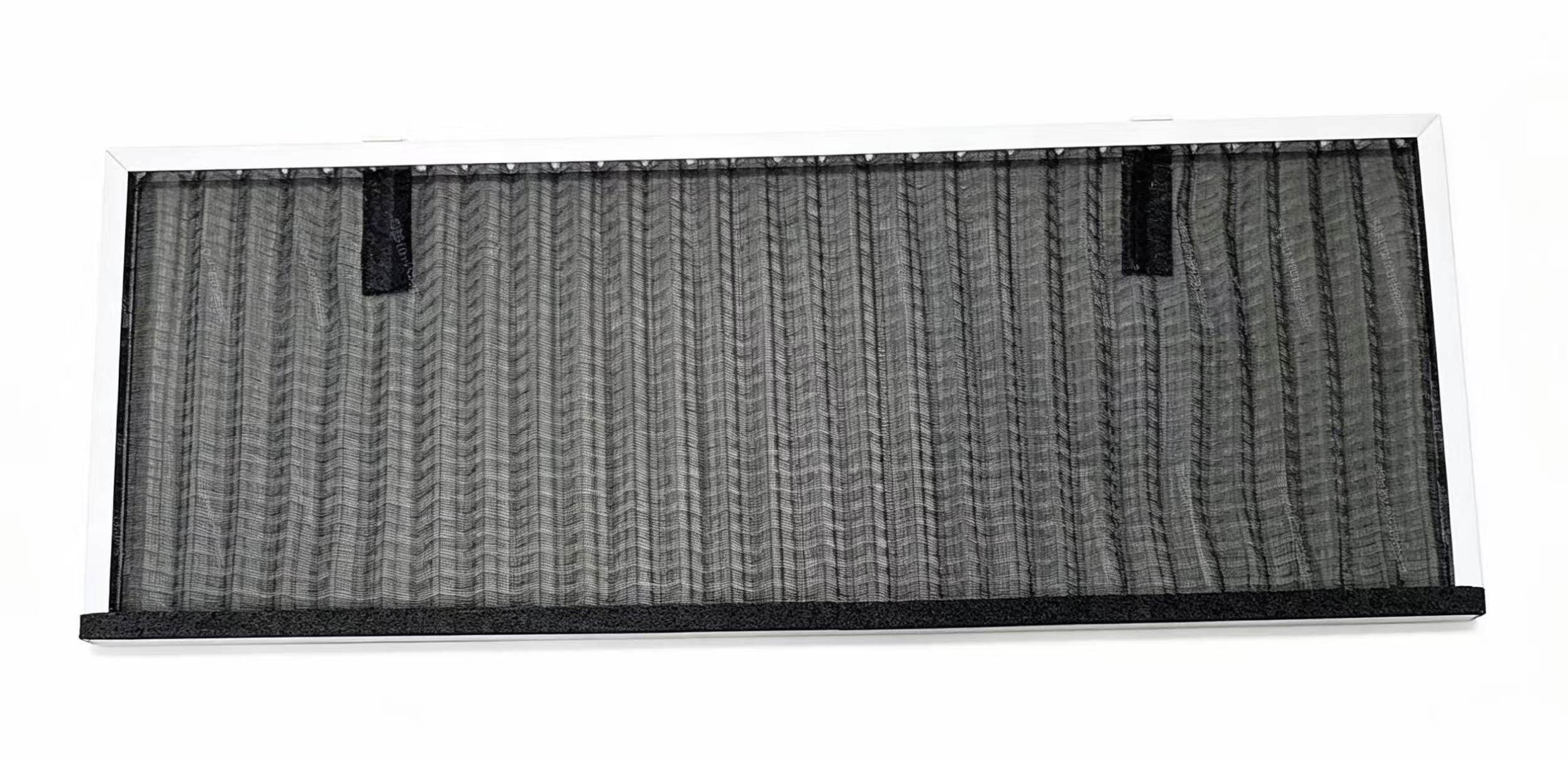
Zanxis washable metal primary filter mesh is a reusable G1–G2 pre-filter made from layered aluminium, stainless steel or galvanised wire mesh in a reinforced frame. It captures ≥5 μm particles and is used in household and commercial air-conditioner outdoor units, greasy kitchen exhaust and humid coastal environments. It suits maintenance teams and OEMs that need verifiable efficiency, low resistance and a washable, long-life first stage of filtration.
| Item | Detail |
|---|---|
| Filter material | Aviation-grade aluminium foil mesh (general use) / 304 stainless steel mesh (coastal corrosion resistance) / galvanised iron wire mesh (economy) |
| Filtration class & efficiency | G1–G2 primary filtration; effectively captures particles ≥5 μm |
| Structure & frame | 3–7 layers of corrugated/pleated expanded mesh interleaved; aluminium alloy / galvanised / stainless steel frame, 1.0–2.0 mm thick, reinforced corners |
| Operating performance | Operating temperature: -20 °C to 250 °C | resistance: ≤50 Pa at 2 m/s face velocity | airflow decay <5% |
| Installation & maintenance | Clip-on / magnetic design for leak-free, easy removal; clean every 1–3 months (monthly in dusty seasons) with low-pressure clean water and neutral detergent |
| Applications & sizes | Household/commercial AC outdoor units, heavy-oil environments, high-humidity salt-spray areas; standard sizes (e.g. 500×500×10 mm) and fully custom sizes available |
Before selecting a mesh grade, confirm the actual face velocity at your installation. The ≤50 Pa resistance figure is stated at 2 m/s; if your system runs at a different speed, ask for the corresponding resistance curve so pressure drop and fan energy are calculated on real data. Confirm the filtration class you need (G1 or G2) and the particle size your process must capture — this product is rated for ≥5 μm. Verify the operating temperature range (-20 °C to 250 °C) against the location; aluminium mesh and stainless steel mesh have different corrosion behaviour in coastal salt spray, so state the environment. Frame thickness (1.0–2.0 mm) and layer count (3–7) should be fixed in the drawing before sampling. Finally, confirm the cleaning interval your maintenance team can sustain: 1–3 months is the recommended range, with monthly cleaning in sand-dust seasons.
The filter is built from 3–7 layers of corrugated or pleated expanded mesh interleaved to form a deep, self-supporting core. The frame is aluminium alloy, galvanised steel or stainless steel, 1.0–2.0 mm thick, with reinforced corners. Clip-on or magnetic mounting keeps the filter in place without air bypass and allows tool-free removal for cleaning. The mesh works by physical interception plus a weak electrostatic effect, and because it is metal it can be washed and reused — there is no disposable media to replace.
Typical use is as the first stage in household and commercial air-conditioner outdoor units, in heavy-oil environments where grease loads are high, and in high-humidity salt-spray areas where 304 stainless steel mesh is preferred. Standard sizes are available, and fully custom sizes are produced to drawing. Cleaning with low-pressure clean water and neutral detergent every 1–3 months (monthly in sand-dust seasons) restores resistance; airflow decay is stated as <5%.
Our own laboratory is CNAS-accredited and can issue test reports for filtration efficiency, dust-holding capacity and resistance. These reports let you verify the G1–G2 class and the ≤50 Pa resistance at 2 m/s before you commit to a production order. Quality control runs through IQC, IPQC and OQC, so incoming mesh, in-process layer stacking and outgoing finished filters are each checked against the agreed specification.
The manufacturing site in Zhongshan, Guangdong, China, covers 50,000 m², including six clean workshops totalling 20,000 m². We have held IATF 16949 (2024) and ISO 9001, ISO 14001 and ISO 45001 certifications, and products meet REACH and RoHS requirements with compliance documents available. With more than 20 years of filtration development and export experience to Europe, the US, Japan and Korea, we support OEM/ODM customisation of size, structure, filter class, frame material, logo and packaging, and have developed over 1,000 filtration solutions. Multiple automated lines support monthly capacity in the millions of pieces.
To quote accurately and prepare a sample, tell us the device or vehicle model, the size or a drawing, the airflow or water flow (as applicable), the operating conditions (temperature, humidity, oil or salt exposure) and the quantity you expect. If you need verification first, ask for the CNAS-accredited test report for efficiency, dust holding and resistance. Send your details through our contact page and we will confirm the specification and sample plan.
Yes. Our CNAS-accredited laboratory can issue reports covering filtration efficiency, dust-holding capacity and resistance. These reports let you verify the G1–G2 class and the ≤50 Pa resistance at 2 m/s before ordering.
After we receive your drawing and operating conditions, we produce the sample to the agreed specification and run any requested tests. The exact duration depends on the customisation and test scope; we confirm the schedule when you send your inquiry.
The filter is rated G1–G2 primary filtration and captures particles ≥5 μm. Efficiency is verified in our CNAS-accredited lab, and the report is available with the sample.
Yes. We offer standard sizes such as 500×500×10 mm and fully custom sizes. Frame material, mesh material (aluminium, 304 stainless steel or galvanised), layer count and mounting style can be specified.
MOQ depends on the specification and customisation. Please state your target quantity in the inquiry so we can confirm the MOQ for your configuration.
Lead time is confirmed per order after the specification and quantity are fixed. We will include it in the quotation once your sample is approved.
The mesh is washable and reusable. Clean it every 1–3 months with low-pressure clean water and neutral detergent, and monthly in sand-dust seasons. Replacement is not routine; airflow decay is stated as <5%.
Send the device or vehicle model, size or drawing, airflow, operating conditions and quantity through our <a href="/en/contact">contact page</a>. We will respond with a specification and sample plan.