
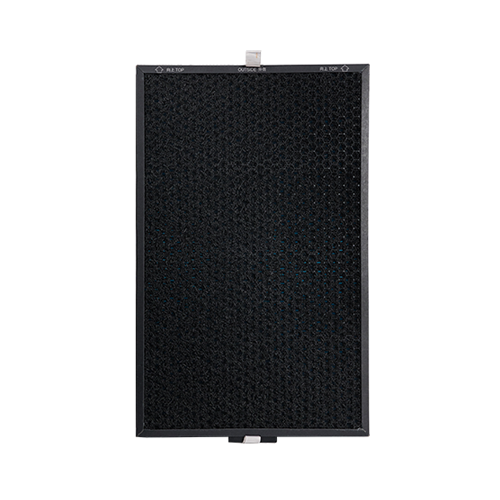
This flat activated carbon filter mesh is a plate-format odour removal filter from Zanxis that adsorbs formaldehyde, benzene, ammonia and other volatile organic compounds (VOCs) from air. It is specified for residential and commercial air purifiers, fresh-air ventilation systems, vehicle cabin air filters, central air-conditioning loops, vacuum cleaner filters and industrial exhaust pre-treatment. Engineers and buyers use it when a defined carbon load, verified efficiency and a repeatable sample sign-off process matter more than a catalogue claim.
| Item | Detail |
|---|---|
| Core material | High-performance activated carbon |
| Structure options | Honeycomb activated carbon filter (sintered carbon block), honeycomb activated carbon filter (plastic honeycomb), honeycomb activated carbon filter (corrugated paper type), activated carbon filter (cylindrical type) |
| Purification performance | High-efficiency adsorption and removal of formaldehyde, benzene, ammonia and other volatile harmful gases (VOCs) |
| Application scope | Residential/commercial air purifiers, fresh-air systems, vehicle air-conditioning filter elements, central air-conditioning circulation systems, vacuum cleaner filter elements, industrial exhaust gas treatment |
| Size and specification | Non-standard customisation according to the customer's specific equipment parameters and requirements |
Before a flat carbon filter is released to production, several values should be written into the specification and confirmed on the drawing. The table above gives the material and structural options; the following points are the ones a QA engineer typically signs off item by item.
Verification follows a fixed sequence so that the sample and the mass-production batch are measured against the same basis.
The flat activated carbon filter mesh is built around a high-performance activated carbon medium held in a plate format. Four structural options are available: a sintered carbon block honeycomb, a plastic honeycomb carrier, a corrugated paper type, and a cylindrical activated carbon filter. The choice depends on the installation space, the required carbon load and the pressure-drop budget of the device.
Because sizes are non-standard, the filter is made to the customer's equipment parameters. The plate format suits flat mounting positions in air purifiers, fresh-air units, central air-conditioning circulation systems and vehicle cabin filter housings, as well as vacuum cleaner filter elements and industrial exhaust pre-treatment stages. In use, the carbon adsorbs formaldehyde, benzene, ammonia and other VOCs; efficiency and life depend on the inlet concentration, airflow, temperature and humidity declared at the inquiry stage. Zanxis supports OEM/ODM customisation of dimensions, structure, carbon grade, frame material, logo and packaging, and has developed more than 1,000 filter solutions.
Verification starts with the laboratory. Zanxis operates a self-built laboratory accredited by CNAS (China National Accreditation Service for Conformity Assessment), which can issue test reports for filtration efficiency, dust holding capacity and resistance. These are the three values most often requested by air-treatment OEMs, and they are measured on the same equipment for samples and production batches.
Quality control runs through IQC, IPQC and OQC — incoming inspection, in-process inspection and outgoing inspection — so each batch is checked before it leaves the plant. The factory covers 50,000 m², including six clean workshops with a combined area of 20,000 m². The management system is certified to ISO 9001, ISO 14001 and ISO 45001, and IATF 16949 automotive quality certification was obtained in 2024. Products meet REACH and RoHS requirements, and compliance documents are available on request.
Zanxis has more than 20 years of experience in filter research and manufacturing and has exported to Europe, the United States, Japan and South Korea for over 20 years. Multiple automated production lines support a monthly capacity of millions of pieces. The company is located in Zhongshan, Guangdong, China.
To receive a sample and the matching test report, send the device or vehicle model, the required size or a dimensioned drawing, the airflow (or water flow where relevant), the operating conditions (temperature, humidity, target gases and concentration), and the estimated quantity. Our team will confirm the carbon grade, structure and test plan, then schedule the sample build. Start the conversation through the contact page.
Yes. Zanxis operates a CNAS-accredited laboratory that can issue reports for filtration efficiency, dust holding capacity and resistance. Reports are measured on the same equipment for samples and production batches. For this product, removal efficiency of 85% or above is achievable under agreed test conditions, and the exact value is stated in the report.
For custom configurations, a sample is typically built within 2–4 weeks after the specification and drawing are confirmed. The sample is then tested in the CNAS-accredited laboratory; report turnaround is quoted with the sample. The approved sample and report become the reference for mass production.
Confirm the carbon iodine number (800–1100 mg/g for coconut-shell or coal-based carbon), the target gases and required efficiency, the operating airflow and allowable pressure drop, the exact dimensions and frame type, and the operating temperature and humidity. These values define the carbon load, structure and expected service life.
Yes. The flat activated carbon filter mesh is non-standard and is made to the customer's equipment parameters. Zanxis offers OEM/ODM customisation of dimensions, structure (sintered carbon block, plastic honeycomb, corrugated paper or cylindrical), carbon grade, frame material, logo and packaging. More than 1,000 filter solutions have been developed.
For standard specifications the MOQ is usually 500–1000 pieces; custom specifications are negotiated. Standard items ship in 7–15 days, while OEM custom orders typically take 25–35 days for mass production. Large orders can be scheduled to shorten delivery where capacity allows.
Under standard conditions — moderate indoor air quality and about 8 hours of operation per day — the service life is typically 6–12 months. Actual life depends on airflow, gas concentration, humidity and temperature. Zanxis can run life testing based on your operating conditions and recommend a replacement interval.
Standard specification samples are usually provided free of charge, with the customer covering international courier costs. Custom samples may incur tooling and sampling fees, which are credited against the bulk order once it is confirmed. CNAS laboratory test reports can be sent with the sample.
Send the device or vehicle model, the required size or a dimensioned drawing, the airflow, the operating conditions and the estimated quantity through the contact page. The team will confirm the carbon grade, structure and test plan, then schedule the sample build. You can reach us at <a href="/en/contact">/en/contact</a>.