
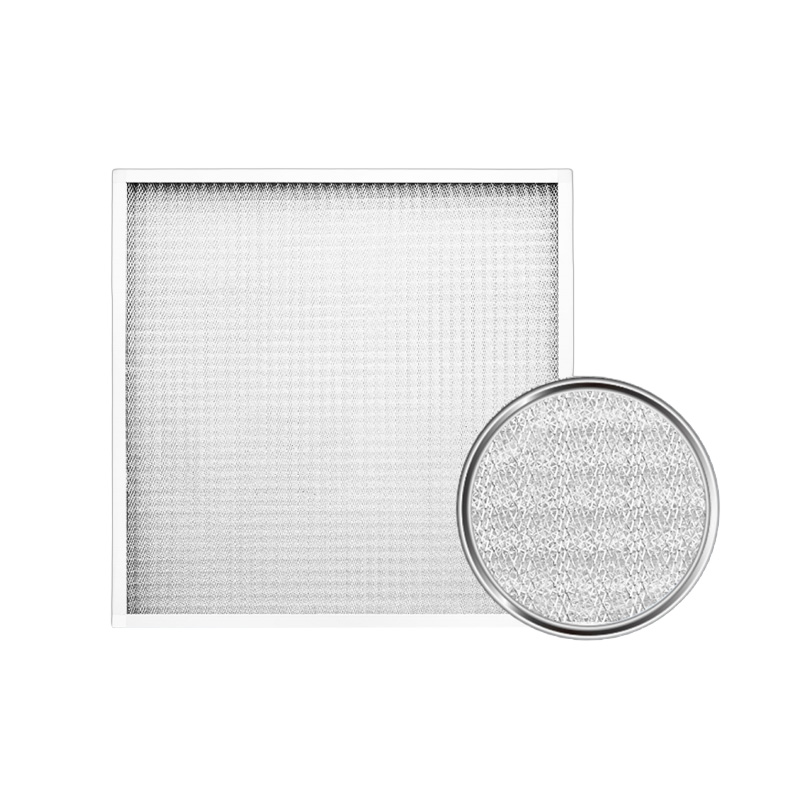
This aluminum pre-filter is a washable, metal-mesh air filter that captures coarse dust, lint, and fibers in commercial HVAC, industrial ventilation, and process intake systems. It is built for facility engineers and OEM buyers who need a durable first-stage filter that tolerates high humidity, high temperature, and repeated cleaning. Zanxis manufactures it with a multi-layer expanded aluminum or stainless steel mesh in an aluminum, stainless steel, or ABS frame. Below we outline the parameters to confirm, how samples and lab reports verify them, and how to request both.
| Item | Detail |
|---|---|
| Product name | Aluminum pre-filter / metal mesh filter |
| Core filter media | Multi-layer wave-shaped expanded aluminum mesh or stainless steel mesh (layer count customizable) |
| Frame material | Aluminum profile, stainless steel, or ABS plastic |
| Physical properties | Low initial resistance, flame retardant, acid and alkali resistant, reusable after water washing |
| Typical applications | High-humidity or high-temperature industrial exhaust; pre-filtration in commercial central air conditioning; insect and leaf pre-filtration in plants; ventilation in acid and alkali workshops |
| Common standard thickness | 1 inch (21 mm) / 2 inch (46 mm) |
| Common sizes (W × H × D) | 12×24×1 in (287 × 592 × 21 mm); 24×24×1 in (592 × 592 × 21 mm); 12×24×2 in (287 × 592 × 46 mm); 24×24×2 in (592 × 592 × 46 mm) |
| Customization (OEM/ODM) | 50,000 m² plant, ISO/IATF16949 certified. Custom lengths, widths, thicknesses, and metal mesh layer counts supported. |
Before you specify this pre-filter, confirm the values that directly affect fit and service life. The filtration efficiency class should be stated against the standard you use: G2–G4 to EN 779 or MERV 1–8 to ASHRAE 52.2, depending on mesh layer count and frame depth. Ask for the initial resistance at your design airflow, because it determines fan energy and the pressure drop budget for downstream filters. Confirm the frame material and mesh layer count against your cleaning method; aluminum and stainless steel are suitable for water washing, while ABS is lighter but may have different temperature limits. Verify the outside dimensions and gasket or edge details from a drawing, not from a nominal size alone. For high-humidity or high-temperature exhaust, confirm that the selected frame and mesh grade match the operating conditions. Finally, request a sample and a test report for the exact configuration you plan to order, so the values on paper match the values in your duct.
We recommend a short, documented sample workflow before production. It keeps the specification honest and reduces the risk of a batch that fits the drawing but not the application.
The filter is built as a 100% metal structure: a multi-layer wave-shaped expanded aluminum or stainless steel mesh held in an aluminum profile, stainless steel, or ABS frame. The all-metal mesh is resistant to corrosion and high temperature, and it can be washed with water and reused, which lowers replacement cost in dusty or greasy intake streams. The pleated metal layers create a large dust-holding surface for coarse interception, so the filter protects downstream medium and high-efficiency stages. Typical uses include central air conditioning pre-filtration in commercial buildings, industrial exhaust in high-humidity or high-temperature processes, plant ventilation where insects and leaves must be stopped, and air exchange in acid and alkali workshops. Standard thicknesses are 1 inch (21 mm) and 2 inch (46 mm), with common face sizes of 12×24 in and 24×24 in. Because the mesh layer count and frame can be customized, the same product family can be specified for different dust loads and cleaning routines. For oil smoke applications, confirm the mesh configuration and cleaning frequency with our team before ordering.
Our own laboratory is CNAS-accredited and can issue test reports for filtration efficiency, dust holding capacity, and resistance. These reports let you compare the pre-filter against your pressure-drop and maintenance targets before a purchase order is placed. Quality control follows IQC, IPQC, and OQC across the production flow, so incoming mesh and frame materials, in-process assembly, and finished goods are each checked against the approved specification. The plant covers 50,000 m², including six clean workshops totaling 20,000 m², and the company holds IATF 16949 (obtained in 2024) as well as ISO 9001, ISO 14001, and ISO 45001 certifications. Products meet REACH and RoHS requirements, and compliance documents can be supplied. Zanxis has more than 20 years of filtration research and manufacturing experience and has exported to Europe, the United States, Japan, and South Korea for over 20 years. OEM/ODM support covers dimensions, structure, filter media grade, frame material, logo, and packaging, with more than 1,000 filtration solutions developed to date. The address is Zhongshan, Guangdong, China.
To move from specification to a verified sample, send us the device or vehicle model, the required size or a drawing, the airflow or water flow, the operating conditions (temperature, humidity, and contaminants), and the quantity you expect to order. With those details we can confirm the mesh layer count, frame material, and efficiency class, and prepare a sample and the corresponding test report for your review. Contact our team to start the sample request.
Yes. Our CNAS-accredited laboratory can issue reports for filtration efficiency, dust holding capacity, and resistance for the agreed configuration. The report identifies the sample and the test standard, so you can compare it with your pressure-drop and maintenance targets. Request the report together with your sample so both reference the same build.
Standard-size samples are typically prepared within a few working days, and custom samples follow the drawing review and build time agreed with our team. The validation itself depends on your inspection and, if needed, the test report review. We recommend signing off the sample and report together before production.
The aluminum pre-filter is typically specified at G2–G4 to EN 779 or MERV 1–8 to ASHRAE 52.2, depending on mesh layer count and frame depth. It is designed for coarse interception of particles above 5 μm, such as dust, lint, and fibers. Confirm the exact class against your application and the report for the selected configuration.
Yes. We support OEM/ODM customization of length, width, thickness, metal mesh layer count, frame material (aluminum, stainless steel, or ABS), logo, and packaging. Standard thicknesses are 1 inch (21 mm) and 2 inch (46 mm), and common face sizes include 12×24 in and 24×24 in. Send a drawing or the device model so we can confirm the build.
For this product, standard sizes typically start at 500–1,000 pieces, while custom sizes are negotiated based on the specification. Stock standard items usually ship in 7–10 days; custom orders generally take 25–35 days depending on quantity and complexity. Confirm the exact MOQ and schedule with our team when you request the sample.
In normal commercial air-conditioning service, the filter is typically cleaned or inspected every 3–6 months, depending on dust load. Because the metal mesh can be washed with water and reused, the overall service period can reach 1–2 years with repeated cleaning. For high-humidity, high-temperature, or oily exhaust, confirm a shorter inspection interval with our team.
Confirm the efficiency class and the standard it is quoted against, the initial resistance at your design airflow, the frame material and mesh layer count, and the exact outside dimensions from a drawing. Also confirm operating temperature and humidity, and the cleaning method. These values determine fit, pressure drop, and service life.
Yes. Send the device or vehicle model, size or drawing, airflow, operating conditions, and expected quantity, and we will propose the configuration with a quotation. We can supply a sample for evaluation and the corresponding test report so the quote is based on verified values. <a href="/en/contact">Contact our team</a> to start.