
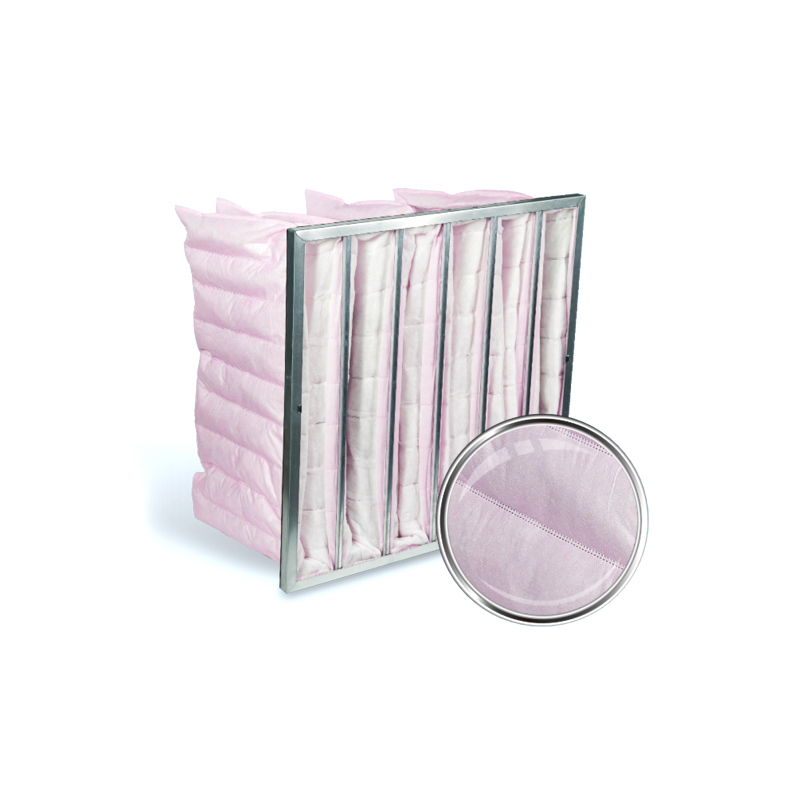
Zanxis bag filters are extended-surface air filters that capture particles across G4 to F9 efficiency grades, using non-woven fiber or fiberglass media in aluminum or galvanized frames. They are specified for pre-filtration and medium-efficiency stages in commercial HVAC, cleanroom fresh-air systems, and industrial ventilation. The design suits facility engineers, HVAC contractors, and OEM buyers who need verifiable performance data before approving a filter for a project.
| Item | Detail |
|---|---|
| Filter grade | G4 / M5 / M6 / F7 / F8 / F9 (pre- to medium-efficiency) |
| Media | High-throughput non-woven fiber or flame-retardant fiberglass |
| Frame material | Aluminum alloy or galvanized steel |
| Rated operating air velocity | 2.5 m/s |
| Standard sizes (W × H × D) | 594 × 594 × 534 mm (24"×24"×21") – typically 6 / 8 / 10 bags 594 × 492 × 534 mm (24"×20"×21") – typically 6 / 8 bags 289 × 594 × 534 mm (12"×24"×21") – typically 3 / 4 bags Other depths such as 381 mm (15") are available |
| Core applications | Central HVAC pre-filtration in commercial buildings, cleanroom fresh-air systems, HVAC filtration in electronics, pharmaceutical, and coating plants |
| Customisation (OEM) | Non-standard sizes and bag counts fully supported, backed by 20 years of manufacturing experience and a CNAS-accredited testing centre |
Before selecting a bag filter, confirm the values that directly affect system resistance, change-out intervals, and compliance. The table below lists the parameters to verify against your project specification; each can be documented in a test report from Zanxis.
These values are not marketing estimates: Zanxis measures efficiency, dust holding, and resistance in its own laboratory and issues reports per batch on request.
For engineers who need physical evidence before a purchase order, Zanxis follows a structured sample verification process:
This workflow typically takes 3–7 working days for sample delivery, depending on customisation complexity.
The Zanxis bag filter is built around a rigid frame that maintains bag geometry under airflow. The media is formed into pockets – typically 3, 4, 6, 8, or 10 bags per filter – to increase surface area within a compact face dimension. Standard face sizes include 594 × 594 mm, 594 × 492 mm, and 289 × 594 mm, with a standard depth of 534 mm and an optional 381 mm depth for space-constrained installations.
Frames are available in aluminum alloy or galvanized steel. The media choice between high-throughput non-woven fiber and flame-retardant fiberglass allows specifiers to balance efficiency, dust-holding capacity, and fire performance. The filter is rated for an operating air velocity of 2.5 m/s, which serves as the reference for published performance data.
Typical installations include central air-handling units in commercial buildings, cleanroom fresh-air systems, and HVAC filtration in electronics, pharmaceutical, and coating plants. The bag filter is often used as a pre-filter ahead of higher-efficiency final filters, protecting them from coarse dust and extending their service life. Its high dust-holding capacity reduces change-out frequency and associated maintenance costs, while the reinforced construction resists damage at higher air velocities.
For OEM projects, Zanxis customises dimensions, bag count, media grade, frame material, labelling, and packaging. With over 20 years of manufacturing experience and more than 1,000 filtration solutions developed, the engineering team can respond to drawings or sample requests quickly.
Zanxis operates a CNAS-accredited laboratory that issues test reports for filtration efficiency, dust-holding capacity, and resistance. These reports are available for each product grade and can be included with samples or bulk shipments, providing documented evidence for project approvals and incoming inspection.
Quality control follows a four-stage process: incoming inspection (IQC) of raw materials, in-process inspection (IPQC) during production, final inspection (FQC), and outgoing inspection (OQC) before shipment. This structure helps maintain consistency across batches and is supported by the company’s IATF 16949 certification (achieved in 2024) and ISO 9001, ISO 14001, and ISO 45001 management systems.
Manufacturing takes place in Zhongshan, Guangdong, China, in a 50,000 m² plant that includes six clean workshops totalling 20,000 m². Multiple automated production lines support a monthly capacity of millions of filter units. Products comply with REACH and RoHS requirements, and compliance documents are available on request. Zanxis has exported to Europe, the United States, Japan, and South Korea for over 20 years, and offers full OEM/ODM support for size, structure, media grade, frame material, logo, and packaging.
To evaluate a Zanxis bag filter for your project, please provide the following details so we can recommend the correct specification and supply the appropriate test documentation:
Send your requirements through our contact page. Our technical team will respond with a specification proposal, sample availability, and the relevant CNAS test reports for verification.
Yes. Zanxis operates a CNAS-accredited laboratory that issues test reports for filtration efficiency, dust-holding capacity, and resistance. These reports are available for each efficiency grade and media type, and can be supplied with samples or bulk orders. The data helps verify performance against your project specification.
The bag filter is available in G4, M5, M6, F7, F8, and F9 grades, covering pre-filtration to medium-efficiency filtration. G4 is typically used for coarse dust, while F7–F9 provide finer particle capture for cleaner applications. The choice depends on the required air quality and the protection needed for downstream filters.
Standard sample orders are typically delivered within 3–7 working days, depending on customisation complexity. Each sample includes a CNAS test report for the agreed parameters. After receiving the sample, you can conduct incoming inspection and a pilot installation to verify fit and performance.
Yes. Zanxis supports full OEM/ODM customisation, including non-standard dimensions, bag counts (3, 4, 6, 8, 10), media grade, frame material, labelling, and packaging. With over 20 years of experience and more than 1,000 filtration solutions developed, the team can work from drawings or samples. Custom samples may incur a development fee that is credited against a bulk order.
For standard specifications, the MOQ is typically 100–200 pieces; custom specifications are negotiated based on requirements. Standard lead time is 15–25 days, while large or highly customised orders may take 30–45 days. The Zhongshan plant has sufficient monthly capacity to support stable delivery for projects and peak seasons.
Under standard HVAC conditions at 2.5 m/s face velocity, the recommended replacement interval is 6–12 months, depending on actual air quality and operating hours. Monitor pressure drop across the filter to determine the optimal change-out point. The high dust-holding capacity of the media helps extend service life and reduce maintenance frequency.
Zanxis holds ISO 9001, ISO 14001, and ISO 45001 management system certifications, and achieved IATF 16949 certification in 2024. Products comply with REACH and RoHS requirements, and compliance documents are available on request. The CNAS-accredited laboratory supports performance verification.
Yes. Standard sizes can be provided as free samples, with the customer covering international freight. Custom samples may incur a development fee, which is credited against a bulk order. Each sample is accompanied by a CNAS test report for verification. Contact us with your specifications to request a sample.