
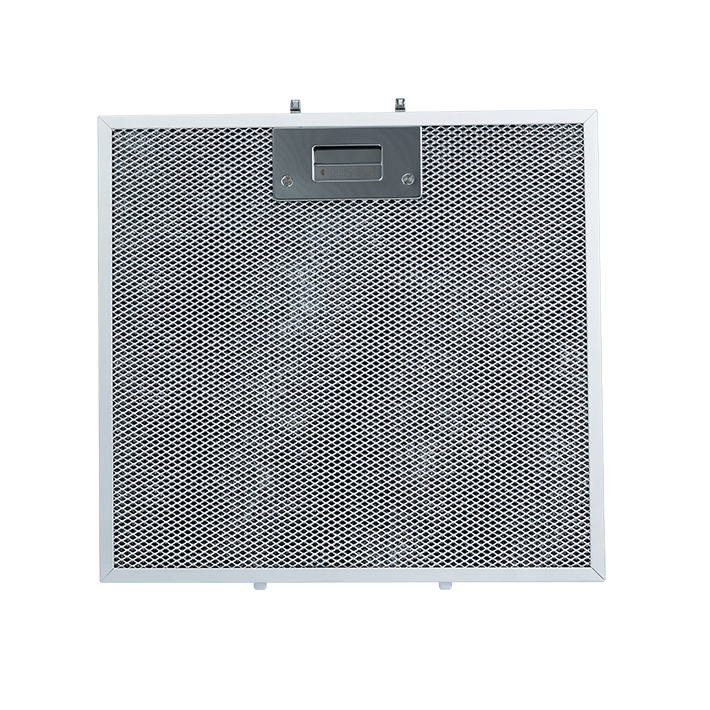
This European range hood filter combines an aluminum foil micro-perforated mesh, flame-retardant polyester fibers, and an activated carbon layer to trap heavy grease and adsorb cooking odors in recirculating range hoods. It is designed for open kitchens and commercial ventilation systems, and it also suits European-style top-draft or side-draft hoods. Zanxis manufactures this filter with customizable frames and UL 900 Class 1/Class 2 fire safety compliance. The following paragraphs outline the key values to confirm, how we verify them through samples and lab reports, and how to request test data for your project.
| Item | Detail |
|---|---|
| Product name | European Range Hood Filter (Activated Carbon Odor Removal) |
| Core materials | Aluminum foil micro-perforated mesh + flame-retardant polyester fiber + granular or powdered activated carbon layer |
| Main function | High-efficiency separation and capture of heavy grease; strong adsorption of cooking odors (e.g., oily smoke, spicy smells) |
| Flame-retardant certification | Compliant with UL 900 Class 1 / Class 2 fire safety testing certification |
| Applications | Open-kitchen recirculating range hoods, commercial kitchen exhaust purification systems, European-style top-draft and side-draft range hoods |
| Frame options | High-strength aluminum alloy profiles, stainless steel frames (optional clips and handles available) |
| Customization & capacity | OEM/ODM flexible manufacturing; company holds IATF16949 / ISO9001 certifications, and a national-level CNAS testing center ensures batch quality |
Before placing an order, we recommend confirming several performance values that directly affect fit and function. First, the grease filtration efficiency: our aluminum mesh filters typically achieve 85%–95% oil removal efficiency, depending on the number of mesh layers (often 5–8 layers) and the mesh density. Second, the airflow resistance and dust holding capacity should be verified against your hood's fan curve. Third, the activated carbon layer's odor adsorption performance and replacement interval need to be defined for your cooking style. Finally, the frame dimensions, handle type, and mounting method must match your hood model. Zanxis provides CNAS-accredited lab reports for efficiency, dust holding, and resistance to help you confirm these values objectively.
We follow a structured sample sign-off process to ensure the filter meets your specifications:
The filter is built around a high-strength aluminum alloy or stainless steel frame, which can be equipped with various clips and handles for easy removal. Inside, layers of aluminum foil micro-perforated mesh and flame-retardant polyester fibers capture grease, while the activated carbon layer adsorbs odors. This construction is designed for recirculating range hoods where exhaust air is not ducted outside. The filter is reusable after cleaning; the aluminum mesh can be washed, but the activated carbon layer should be replaced when odor control diminishes. For commercial kitchen exhaust purification, the filter helps reduce grease carryover and odors.
Zanxis operates a CNAS-accredited laboratory that issues test reports for filtration efficiency, dust holding capacity, and airflow resistance. These reports provide verifiable data for your engineering team. Our production is governed by IATF 16949 (achieved in 2024) and ISO 9001, ISO 14001, and ISO 45001 systems. The 50,000 m² plant includes 20,000 m² of clean workshops across six rooms, and multiple automated lines support a monthly capacity of millions of pieces. IQC, IPQC, and OQC checks are applied throughout production to maintain batch consistency. Products comply with REACH and RoHS regulations, and we can provide compliance documents. With over 20 years of export experience to Europe, the US, Japan, and South Korea, we support OEM/ODM customization of size, structure, filter grade, frame material, logo, and packaging.
To request samples and test reports, please provide the following details: your device or vehicle model, required size or drawing, airflow or water flow (if applicable), operating conditions (temperature, humidity, contaminants), and estimated quantity. This information helps us recommend the right configuration and provide relevant lab data. Contact our team to start the verification process.
Yes, Zanxis can provide test reports from our CNAS-accredited laboratory for filtration efficiency, dust holding capacity, and airflow resistance. These reports are generated using standard test methods and can be shared for your verification. Please contact us with your specific requirements.
Sample production typically takes 3–7 days after we confirm the specifications. Once samples are ready, we can also perform lab testing, which may add a few days. The overall validation timeline depends on your testing and approval process.
For standard models, the MOQ is usually 500–1,000 pieces. For customized models, the MOQ is generally 2,000–3,000 pieces, but this can be negotiated based on your order details. Please contact us to discuss your specific needs.
Bulk order lead time is typically 25–35 days, depending on order quantity and customization complexity. We have a 50,000 m² production facility in Zhongshan, Guangdong, which supports stable capacity for large orders.
The replacement interval depends on cooking frequency and style. As a general guide, the activated carbon layer should be replaced when odor adsorption efficiency noticeably decreases, often every 3–6 months for typical household use. The aluminum mesh can be cleaned and reused.
Yes, we support full customization based on your drawing or sample, including dimensions, mesh layers, frame material, handle type, and logo. Our engineering team can assist with structural optimization to ensure proper fit and performance.
We provide samples for testing. Standard models can be offered free of charge, with the customer covering shipping costs. Customized samples may incur a sampling fee, which can be deducted from bulk orders. We encourage sample validation before ordering.
We implement IQC, IPQC, and OQC throughout production, and our CNAS lab tests samples from each batch for key parameters. Our IATF 16949 and ISO 9001 systems further support consistent quality. Please inquire for detailed quality control plans.