
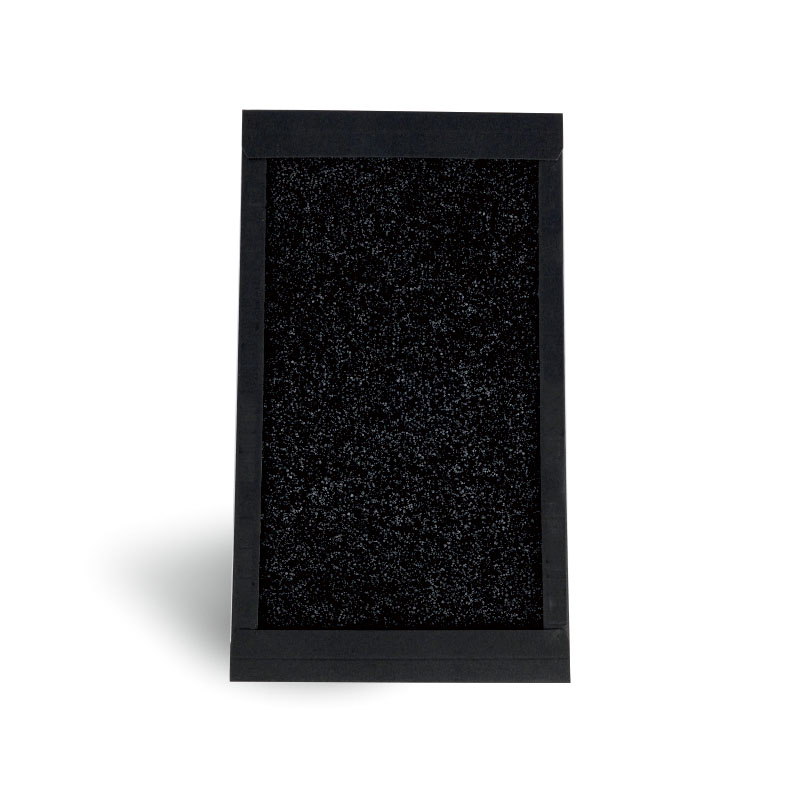
The Zanxis fresh air / fresh air conditioning odor removal filter is a composite filter that combines a polypropylene (PP) media layer with a modified activated carbon layer to capture fine particulate matter (such as PM2.5 and pollen) and adsorb odors and gases (including formaldehyde and TVOCs). It is designed for residential and commercial fresh air systems, fresh air air conditioners, and HVAC applications. Zanxis manufactures this filter with customizable dimensions and efficiency grades from F7 to H13, serving OEM and ODM customers who require documented performance and batch consistency.
| Item | Detail |
|---|---|
| Product name | Fresh Air System / Air Conditioner Composite Filter |
| Core filter media | Composite PP (polypropylene) filter paper + modified odor-removal activated carbon |
| Particulate filtration efficiency | F7 / F8 / F9 (medium efficiency) up to H11 / H12 / H13 (HEPA high efficiency) |
| Core performance | Dual function: removal of fine particulate matter (PM2.5, pollen) + deep adsorption of formaldehyde, TVOC and other odors |
| Product application categories | Fresh air system odor removal filter, fresh air air conditioner high-efficiency filter, fresh air machine HEPA composite filter |
| Main application scenarios | Residential wall-mounted fresh air machines, cabinet-type fresh air air conditioners, residential and commercial central fresh air systems (HVAC) |
| Customization (size and structure) | Molded and fabricated entirely to customer unit requirements (supports flat panel, V-bank folded, and composite configurations) |
| Quality and certification | Each unit undergoes rigorous air resistance and purification efficiency testing before shipment. Production complies with ISO 9001 quality management system and IATF 16949 international certification; materials are environmentally safe. |
When specifying this filter, several parameters directly affect fit and performance. First, confirm the required particulate filtration efficiency class—F7, F8, F9, H11, H12, or H13—because this determines the media selection and expected particle capture. Second, verify the airflow rate and initial resistance at your operating conditions; these influence energy use and filter life. Third, define the target gases (e.g., formaldehyde, TVOC, ammonia, hydrogen sulfide) and their concentrations so that the activated carbon type and loading can be optimized. Fourth, confirm the physical dimensions, including frame size, thickness, and any gasket or mounting requirements, to ensure drop-in compatibility. Fifth, agree on the replacement interval based on local air quality and daily runtime; Zanxis can propose a carbon iodine value and dust holding capacity to balance lifespan and cost. Finally, clarify documentation needs: material safety data sheets, RoHS/REACH compliance, and test reports for efficiency, resistance, and dust holding capacity are available upon request.
To validate performance before mass production, Zanxis follows a structured sample verification process:
The Zanxis fresh air / fresh air conditioning odor removal filter is constructed with a composite PP media layer that captures fine particles, followed by a modified activated carbon layer for odor and gas adsorption. The media is pleated to maximize surface area within a compact footprint. The filter is available in flat panel, V-bank folded, and composite configurations to suit different housing designs. It is intended for use in fresh air systems, fresh air air conditioners, and central HVAC systems where both particulate and odor control are required. The filter is not washable; replacement is recommended when resistance rises or after the suggested service interval. Zanxis supports full customization of dimensions, frame material, filter class, carbon type and loading, and packaging to meet OEM requirements.
Zanxis operates a CNAS-accredited laboratory that issues test reports for filtration efficiency, dust holding capacity, and resistance. These reports provide verifiable data for your technical review. Production is governed by ISO 9001, ISO 14001, and ISO 45001 systems, and since 2024, IATF 16949 certification for automotive quality management. Our quality control follows IQC, IPQC, and OQC protocols to ensure consistency from incoming materials to finished filters. The manufacturing facility covers 50,000 m², including 20,000 m² across six cleanrooms, supporting a monthly capacity of several million filters. With over 20 years of experience and more than 1,000 filtration solutions developed, we collaborate with customers to tailor products to their exact specifications. Products comply with REACH and RoHS regulations, and compliance documentation is available.
To request samples or test reports, please provide the following details: your device or vehicle model, required dimensions or a drawing, airflow or water flow rate, operating conditions (temperature, humidity, pollutant levels), and estimated quantity. This information allows us to recommend the appropriate configuration and prepare an accurate quotation. Contact us via our contact page to start the process.
Yes. Zanxis can provide test reports from our CNAS-accredited laboratory covering filtration efficiency, dust holding capacity, and resistance. These reports are generated for the specific configuration you order, ensuring the data reflects the actual product.
For standard configurations, sample fabrication typically takes 7–10 days after specification confirmation. Custom tooling or specialized media may extend the timeline. We recommend planning for additional time if third-party testing is required.
The MOQ for standard models is generally 500–1,000 pieces, depending on specifications. Customized models typically require 1,000–2,000 pieces. Sample orders can be accommodated with flexible quantities.
For standard stock items, lead time is 7–10 days. Custom orders typically require 25–35 days for the first order (including tooling and sample approval), and repeat orders take 15–25 days. We can discuss scheduling for long-term agreements.
Under normal usage conditions (PM2.5 annual average around 35 µg/m³, 8–12 hours daily operation), we recommend replacement every 6–12 months. Actual life depends on local air quality, usage patterns, and pollutant concentrations. We can help tailor the carbon loading and dust holding capacity to optimize replacement intervals for your application.
Yes. Zanxis offers full OEM/ODM customization, including dimensions, frame material, filter class (F7–H13), carbon type and loading, and packaging. We can also adjust the filter structure (flat, V-bank, or composite) to fit your housing. Provide your specifications or a drawing for a tailored proposal.
We implement IQC, IPQC, and OQC throughout production, and each batch is tested for resistance and efficiency before shipment. Our CNAS-accredited lab provides verifiable reports, and our ISO 9001 and IATF 16949 systems support process control. This ensures that every shipment meets the agreed specifications.
Yes. We provide samples for evaluation; standard configurations are typically free, with the customer covering freight. Custom samples may incur a fee, which can be credited against a bulk order. Contact us with your requirements to arrange samples and any accompanying test reports.