
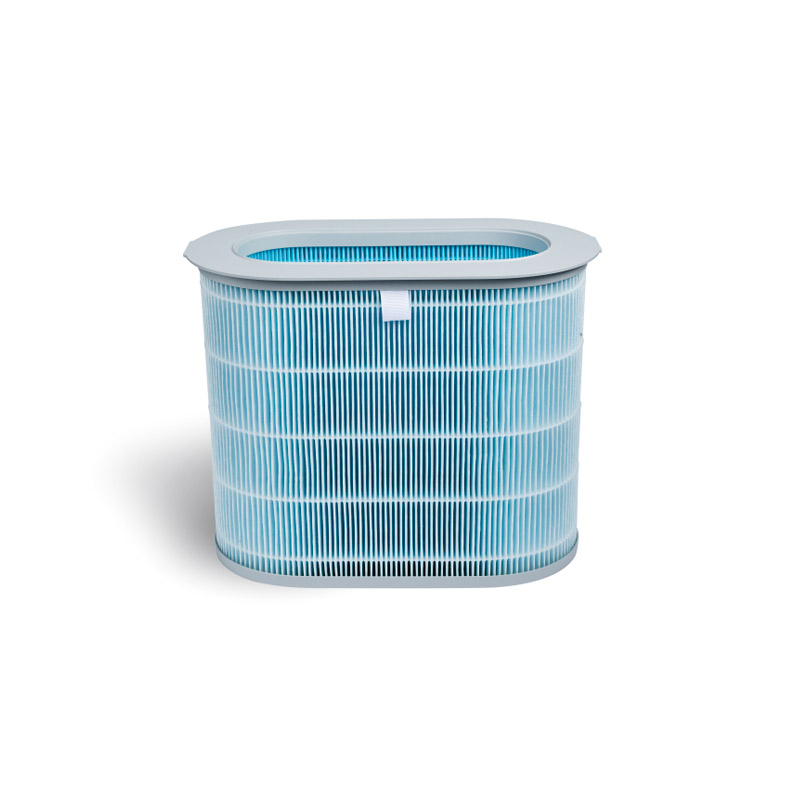
This Zanxis filter is a composite panel HEPA filter for fresh air systems and fresh air air-conditioning units. It combines polypropylene (PP) media for particulate removal with a modified activated carbon layer for odour and gas-phase adsorption, and it is available in efficiency classes from F7/F8/F9 up to H11/H12/H13. It is designed for residential wall-mounted fresh air machines, cabinet fresh air air conditioners, and central HVAC systems, and it is aimed at OEM/ODM buyers who need documented performance and sample validation before production.
| Item | Detail |
|---|---|
| Product name | Fresh air system / fresh air air conditioner composite filter |
| Core filtration media | Composite PP (polypropylene) filter paper plus modified activated carbon for odour removal |
| Dust filtration efficiency | Available across F7 / F8 / F9 (medium efficiency) up to H11 / H12 / H13 (HEPA high efficiency) |
| Core performance | Dual action: removal of fine particulate matter (PM2.5, pollen) plus deep adsorption of formaldehyde, TVOC and other odours |
| Application categories | Odour-removal filters for fresh air systems; high-efficiency filters for fresh air air conditioners; HEPA composite filter elements for fresh air machines |
| Main application scenarios | Residential wall-mounted fresh air machines, cabinet fresh air air conditioners, residential and commercial central fresh air (HVAC) systems |
| Size and specification customisation | Tooling and production fully to the customer's unit requirements; flat panel, V-bank folded and composite formats supported |
| Quality and certification | Air resistance and purification efficiency tested before shipment; production follows ISO 9001 and IATF 16949; materials are environmentally safe |
Before a sample is built, align on the numbers that will define acceptance. The efficiency class is the first: F7/F8/F9 sit in the medium-efficiency range, while H11/H12/H13 are HEPA grades, and the correct choice depends on the particles your system must capture and the pressure budget of the fan. Confirm the rated airflow and the initial resistance at that airflow, because a filter that meets an efficiency target but exceeds the fan's static pressure will underperform in the installed unit.
Confirm the dust holding capacity you expect between service intervals, and the activated carbon specification for the odour-removal duty, since gas-phase life depends on the carbon load and the contaminant mix. Confirm the exact dimensions, frame type and fold geometry from your drawing or unit sample, and state the operating conditions: temperature, humidity and any vibration or space constraints. Finally, define the test conditions and reporting you need, so that the CNAS-accredited laboratory reports match the values your own qualification plan will check. Zanxis supports OEM/ODM customisation of size, structure, media grade, frame material, logo and packaging, with more than 1000 filter solutions developed to date.
The filter uses composite PP media as the particulate layer, formed into a panel or V-bank configuration to provide filtration area within the space allowed by the unit. Behind or combined with that media is a modified activated carbon layer, selected for adsorption of formaldehyde, TVOC and odours, giving one filter element both particle and gas-phase duty. This construction suits fresh air systems where outdoor air is drawn in continuously, and fresh air air conditioners where the filter sits in the outdoor-air path.
Because the element is built to the customer's unit requirements, dimensions, frame material and fold count follow your drawing rather than a fixed catalogue size. Typical service life in a fresh air system is 6–12 months, depending on outdoor air quality, daily running hours and the pre-filter arrangement; in areas with high PM2.5, pairing the HEPA stage with G4 primary and F7/F8 medium-efficiency pre-filters helps extend the main filter's life. The product is intended for residential wall-mounted fresh air machines, cabinet fresh air air conditioners and residential or commercial central fresh air systems.
Zanxis operates its own laboratory, accredited by CNAS (China National Accreditation Service for Conformity Assessment), which can issue test reports for filtration efficiency, dust holding capacity and resistance. These reports let your engineers compare declared values with measured ones before a purchase decision. Every production batch passes IQC for incoming material, IPQC during production and OQC before shipment, and the factory holds ISO 9001, ISO 14001 and ISO 45001 system certifications, with IATF 16949 automotive quality management certification obtained in 2024.
The manufacturing base covers 50,000 m², including six clean workshops totalling 20,000 m², where HEPA filters are produced in a controlled environment to limit secondary contamination. Multiple automated production lines support monthly capacity in the millions of pieces. Products meet REACH and RoHS environmental requirements, and compliance documents can be supplied. Zanxis has more than 20 years of filtration R&D and manufacturing experience, exporting to Europe, the United States, Japan and South Korea for over 20 years, and is located in Zhongshan, Guangdong, China.
To start a technical review, send the device or vehicle model, the required size or a drawing, the airflow or water flow, the operating conditions, and the quantity you plan to order. With those details Zanxis can confirm the feasible efficiency class, propose a construction and state the sample lead time and MOQ. Use the contact page to submit your specification and request samples with CNAS-accredited test reports.
Yes. Zanxis operates a CNAS-accredited laboratory that can issue reports covering filtration efficiency, dust holding capacity and resistance. These reports can be supplied with samples so your team can compare measured values with the declared specification.
Standard specifications can be supplied quickly, while custom samples typically take 7–15 days to produce. The full validation then depends on your own bench or unit testing, for which the CNAS reports give a baseline for comparison.
The filter covers F7/F8/F9 medium-efficiency grades up to H11/H12/H13 HEPA grades, with a modified activated carbon layer for formaldehyde, TVOC and odours. The choice depends on the particles to be captured and the fan's pressure budget, so confirm rated airflow and initial resistance before selecting.
Yes. Zanxis supports OEM/ODM customisation of size, structure, media grade, frame material, logo and packaging, with flat panel, V-bank folded and composite formats available. Production is built to your drawing or unit sample, and more than 1000 filter solutions have been developed to date.
Standard products typically have an MOQ of 500–1000 pieces, while custom products are negotiated according to specification complexity; flexible small-batch trial orders are supported for new customers. Standard stock items ship within 7–15 days, custom first orders usually take 25–35 days, and repeat orders 15–25 days.
Under standard fresh air system conditions, typical service life is 6–12 months, depending on outdoor air quality, running hours and the pre-filter arrangement. In high-PM2.5 areas, using G4 primary and F7/F8 medium-efficiency pre-filters helps extend the HEPA stage's life.
Yes. Zanxis obtained IATF 16949 automotive quality management certification in 2024 and can supply technical documents, material certifications and batch traceability records to support PPAP requirements. Structural customisation per vehicle model is supported for Tier 1 and Tier 2 suppliers.
Send your device or vehicle model, required size or drawing, airflow, operating conditions and planned quantity through the contact page. Zanxis will confirm the feasible specification, sample lead time, MOQ and price, and can include CNAS-accredited test reports with the sample.