
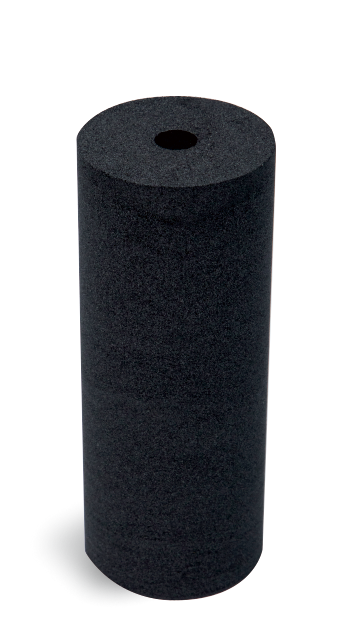
This sintered activated carbon block filter cartridge, sized Ф51×127 mm, is a coconut-shell-carbon and ion-exchange-resin water filter for purifier and refrigerator applications. It reduces chlorine, taste and odour, colour, and heavy metals such as lead and mercury, while helping to soften water and prevent scaling. It suits household reverse-osmosis purifiers, direct-drinking dispensers, refrigerators with built-in water filters, and commercial coffee machines. The brand is Zanxis.
| Item | Detail |
|---|---|
| Product name | Water purifier / refrigerator carbon block water filter (CTO filter) |
| Core filtration materials | High-iodine-value coconut shell activated carbon + food-grade ion exchange resin |
| Core performance | Softens water and helps prevent scaling; strongly adsorbs residual chlorine (bleach); removes abnormal colour and odour; intercepts harmful heavy metals such as lead and mercury |
| Precision and service life | Uniform microporous structure, high initial flow, high filtration precision and no black powder release; large saturated adsorption capacity and long service life |
| Common size references (outer diameter × length, mm) | Ф60×130 / Ф62×240 / Ф37.5×75 / Ф38×57 / Ф40×195 / Ф51×127 / Ф32×126 / Ф32×106 |
| Main end applications | Household reverse-osmosis purifiers (RO pre-filter CTO / post-filter T33), direct-drinking dispensers, side-by-side refrigerator built-in water filters, commercial coffee machines |
| Customisation service | Full OEM/ODM support. Length, diameter and inner/outer diameter ratios can be tooled to device requirements; end-cap welding customisation is supported. |
| Quality certification systems | The company's 20,000 m² production base is ISO 9001 and IATF 16949 certified. Filter media comply with strict drinking-water safety and hygiene standards, with quality control backed by a CNAS-accredited testing centre. |
Before approving a carbon block for a purifier platform, confirm five values against your own test protocol. First, filtration precision: the standard rating for this sintered carbon block is 5 microns, with 1–10 microns available on request, so agree the rating and the particle-count method before sampling. Second, chlorine reduction: the stated removal rate is greater than 95%, a figure that should be verified with your inlet chlorine concentration and flow rate. Third, rated flow: approximately 1.0 L/min per cartridge; confirm it at your system pressure, because flow falls as the block loads. Fourth, service life: 6–12 months or approximately 6,000 L of treated water, whichever comes first, depending on feed-water quality. Fifth, physical integrity: the block is described as releasing no black powder, which matters for downstream membranes and taste.
These values are starting points for a specification, not a substitute for your own validation. Water chemistry, temperature and pressure all shift performance, so the practical approach is to fix the test conditions first and compare cartridges under identical ones.
Zanxis recommends a staged sign-off rather than a single spot check. The sequence below keeps the comparison fair and produces a record you can attach to an internal approval.
The cartridge is formed from high-iodine-value coconut shell activated carbon combined with food-grade ion exchange resin, sintered into a rigid block with a uniform microporous structure. The carbon adsorbs residual chlorine, abnormal colour and odour, and organic contaminants; the resin contributes softening and helps intercept heavy metals such as lead and mercury. Because the block is self-supporting, it holds its shape in the housing and is described as not releasing black powder, an advantage where a reverse-osmosis membrane sits downstream.
Typical placements are the CTO pre-filter stage or T33 post-filter stage of a household RO purifier, the filter circuit of a direct-drinking dispenser, the built-in water filter of a side-by-side refrigerator, and the water line of a commercial coffee machine. The Ф51×127 mm size is one of eight reference sizes in the range, alongside Ф60×130, Ф62×240, Ф37.5×75, Ф38×57, Ф40×195, Ф32×126 and Ф32×106 mm. Customisation covers length, diameter, inner/outer diameter ratio and end-cap welding, so a cartridge can be matched to an existing housing rather than the housing redesigned around a stock part.
Verification at Zanxis starts with the laboratory. The company's self-built laboratory is CNAS-accredited and can issue reports covering filtration efficiency, dust holding capacity and resistance. Those reports let a buyer compare a claimed efficiency with a measured one under stated conditions, which is the basis of any sensible sample sign-off.
Production quality is controlled through IQC, IPQC and OQC: incoming material inspection, in-process patrol inspection and outgoing inspection. The 50,000 m² plant includes 6 clean workshops totalling 20,000 m², which limits secondary contamination during filter production and assembly. The manufacturing base is ISO 9001 and IATF 16949 certified — IATF 16949 was added in 2024 — and holds ISO 14001 and ISO 45001. Products meet REACH and RoHS requirements, and compliance documents can be supplied. With more than 20 years of filtration development and manufacturing, and more than 20 years of continuous export to Europe, the United States, Japan and South Korea, Zanxis supports OEM/ODM across dimensions, structure, media grade, logo and packaging, with more than 1,000 filtration solutions developed to date. Multiple automated lines support monthly output in the millions of pieces. The address is Zhongshan, Guangdong, China.
To move from specification to sample, send the following to the Zanxis team: the device or vehicle model, the required size or a drawing, the airflow or water flow, the operating conditions (pressure, temperature, feed-water quality), and the quantity you plan to order. With those details, the team can confirm the closest standard size, quote a custom tooling route if needed, and arrange samples and the relevant test reports. Start at /en/contact.
Yes. Zanxis can provide reports from its CNAS-accredited laboratory covering filtration efficiency, dust holding capacity and resistance. Share your test conditions so the reported values can be compared with your own protocol. For project-specific requirements, contact the team to discuss the applicable report.
Standard samples are typically ready in 3–5 days, while custom samples take 10–20 days depending on development difficulty. Validation itself depends on your test schedule. Zanxis recommends side-by-side testing of flow, pressure drop and chlorine reduction under identical conditions before approval.
The standard filtration precision is 5 microns, with 1–10 microns available on request. The stated chlorine removal rate is greater than 95%, and the block is described as releasing no black powder. Confirm these values under your own inlet chlorine concentration and flow rate.
Yes. Zanxis supports OEM/ODM customisation of length, diameter and inner/outer diameter ratio, and offers end-cap welding. Send your housing drawing or dimensions and the team will confirm the tooling route. Eight reference sizes are listed, from Ф32×106 to Ф62×240 mm.
For standard sintered carbon block models, the MOQ is usually 1,000–2,000 pieces depending on specification and packaging; custom models are recommended from 5,000 pieces. Standard stock ships in 7–15 days, while OEM production runs typically take 25–35 days. Confirm the exact figure with the team for your configuration.
The recommended service life is 6–12 months or approximately 6,000 L of treated water, whichever comes first. Actual life depends on feed-water quality and daily volume. Monitor flow and taste as practical indicators, and confirm the interval for your application during sample validation.
Quality control runs through IQC, IPQC and OQC — incoming material inspection, in-process patrol inspection and outgoing inspection. The CNAS-accredited laboratory supports these checks with efficiency, dust holding and resistance testing. Ask for the batch documentation when you place an order.
Send the device or vehicle model, required size or drawing, water flow, operating conditions and quantity through <a href="/en/contact">/en/contact</a>. The team will confirm the size, sample route and applicable reports. Standard samples are typically 2–5 pieces with courier costs borne by the customer.