
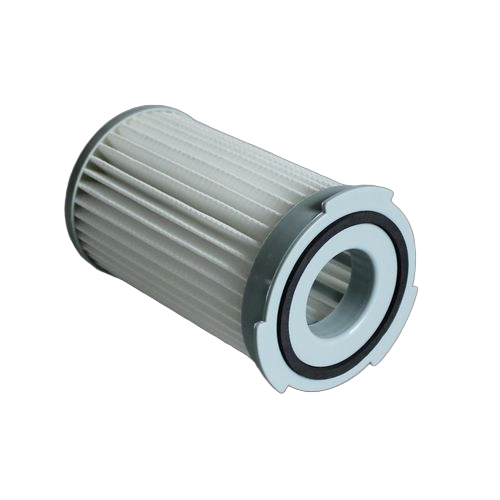
This is a cylindrical washable HEPA filter element for handheld and cordless vacuum cleaners, robot vacuums and mattress mite removers, built on PTFE membrane or composite PP media to intercept PM2.5 particles, dust mites, pollen and hair before air leaves the dust cup. It is made by Zanxis for OEM and ODM programmes, so dimensions, frame, seal and media grade are set against your device drawing rather than a catalogue number. Buyers who need repeatable filtration values, lab evidence and a sample sign-off before mass production are the intended audience.
| Item | Detail |
|---|---|
| Product name | Vacuum cleaner filter element (cylindrical / conical format) |
| Core filtration media | High-precision PTFE microporous membrane / composite PP meltblown / antibacterial treated filter paper |
| Core purification function | Intercepts fine particles from the dust cup (PM2.5), dust mites, pollen and hair, limiting secondary contamination through the exhaust |
| Fluid and airflow characteristics | High-porosity, breathable design with very low operating resistance and high dust holding capacity; helps prevent motor overheating and supports battery runtime |
| Main end applications | Handheld cordless vacuums, smart robot vacuums, mattress mite removers, wet-dry floor cleaners, compact car vacuums |
| Frame and dimension customisation | Made to the device airflow path and dust cup dimensions; eco-friendly injection-moulded frame and rubber sealing ring edge finishing for airtight, dust-tight fit |
| Company certification systems | 50,000 m² production base and a CNAS-accredited testing centre; ISO 9001, ISO 14001 and IATF 16949 quality management systems |
Before a tool is cut, four groups of values should be fixed in writing. First, filtration efficiency at the particle size your market claims, expressed as a grade and a percentage rather than a general statement. Second, initial pressure drop at your appliance's working airflow, because low resistance is what protects suction and motor temperature. Third, dust holding capacity, which sets how long the filter lasts between washes. Fourth, the dimensional stack: outer diameter, height, pleat count and end-cap geometry, plus the sealing ring that keeps the dust cup airtight.
Media choice belongs in the same conversation. PTFE membrane, composite PP meltblown and antibacterial treated paper behave differently in wash cycles and in humid pick-up, so the grade should match the cleaning routine the end user follows. Zanxis produces against the device airflow path and dust cup dimensions, so the filter is a fitted component, not a trimmed generic disc.
The element is built around a pleated media pack in a cylindrical or conical format, held by an injection-moulded frame and finished with a rubber sealing ring at the edge so the filter seats airtight in the dust cup. The high-porosity media keeps operating resistance low, which matters for two reasons: suction is preserved as the cup fills, and the motor is not worked harder than the design intends. High dust holding capacity extends the interval between cleaning cycles.
Because the media is washable, the filter can be rinsed and returned to service rather than replaced after every heavy clean. It is aimed at handheld cordless vacuums, robot vacuums, mattress mite removers, wet-dry floor cleaners and compact car vacuums. Dimensions, pleat count, frame material, media grade, logo and packaging are all set per order, which is how a filter ends up matching a specific dust cup instead of approximating one.
Zanxis operates its own laboratory accredited by CNAS (China National Accreditation Service for Conformity Assessment), which issues reports covering filtration efficiency, dust holding capacity and resistance. Those are the three values most often requested by buyers qualifying a vacuum filter, and they are measured on the same media and construction that go into production.
Quality control runs through IQC, IPQC and OQC, so incoming media, in-process pleating and finished elements are each checked against the agreed specification. The company holds IATF 16949 automotive quality management certification, obtained in 2024, alongside ISO 9001, ISO 14001 and ISO 45001. Products meet REACH and RoHS environmental requirements and compliance documents can be supplied.
The production base covers 50,000 m² in Zhongshan, Guangdong, China, including 6 clean workshops totalling 20,000 m². With more than 20 years of filtration development and manufacturing, multiple automated production lines and monthly capacity in the millions of pieces, Zanxis has developed over 1,000 filtration solutions and has exported to Europe, the United States, Japan and Korea for more than 20 years.
To quote accurately, Zanxis needs the device or vehicle model, the size or a drawing, the airflow or water flow the appliance runs at, the operating conditions, and the quantity you plan to order. Send these details and the team will confirm the media grade, the values to be reported and the sample route before production. Start at contact us.
Yes. Zanxis runs a CNAS-accredited laboratory that issues reports for filtration efficiency, dust holding capacity and resistance on the agreed construction. The report is supplied with the samples so you can compare measured values against your specification before approving mass production.
The filter is built on PTFE membrane, composite PP meltblown or antibacterial treated paper, and the grade is set per order against the efficiency you require at your stated particle size. Efficiency, resistance and dust holding are confirmed in the CNAS-accredited laboratory rather than assumed from the media datasheet.
Samples are built to your device model, drawing or physical sample, including frame and rubber sealing ring, so they can be seated in the actual dust cup. You then run fit and field checks on your own units and sign off the drawing together with the reported values before production begins.
Timing depends on whether the format is close to an existing tool or needs a new mould, and on how quickly the drawing is approved. Zanxis confirms the sample schedule when the device model, drawing and target values are received, and the laboratory report is issued with the samples.
MOQ is set per product and per specification, so it is confirmed with the quotation once the dimensions, media grade and packaging are fixed. Quantity is one of the inputs Zanxis asks for at inquiry stage, along with device model, drawing, airflow and operating conditions.
The washable media allows rinsing and reuse, and the interval depends on dust load, the appliance's airflow and the dust holding capacity measured for your grade. Zanxis reports that capacity so you can set a cleaning interval in the user manual based on evidence rather than guesswork.
Yes. Dimensions, pleat count, frame material, media grade, logo and packaging are set per order against the device airflow path and dust cup, and rubber sealing ring edging is available for an airtight fit. This is how Zanxis has developed more than 1,000 filtration solutions for export markets.