
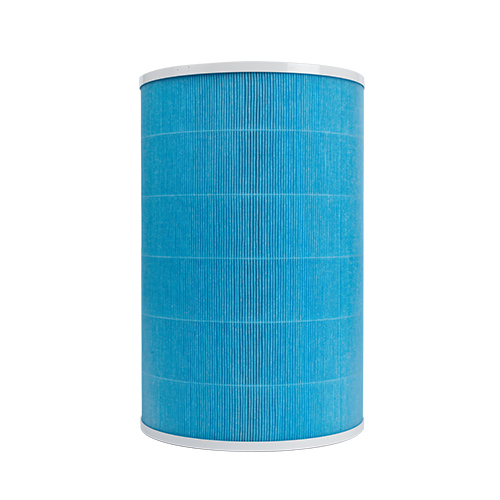
This cylindrical HEPA filter is a 360° intake filter element for air purifiers, new-air systems and similar equipment, available in efficiency grades from medium to HEPA (H11–H14) and in custom diameters and heights. It captures fine dust and allergens, and can be combined with a pre-filter mesh or activated carbon layer. Zanxis manufactures it for appliance brands and OEM/ODM buyers who need documented performance and sample verification.
| Item | Detail |
|---|---|
| Product name | Cylindrical HEPA filter for air purifiers |
| Core materials | High-flux PP (polypropylene), PP+PET composite nonwoven, PTFE (polytetrafluoroethylene) |
| Filtration efficiency | Customisable from medium-efficiency to HEPA grade according to the end product; effectively removes airborne fine dust and allergens |
| Structure | 360° cylindrical design; inner and outer layers can be combined with a pre-filter mesh or activated carbon layer as required |
| Dimensions | Fully customisable; any diameter and height can be produced to match the purifier cavity |
| Applications | Household air purifiers, commercial new-air systems, car air purifiers, high-end vacuum cleaners and similar environmental purification appliances |
| Certifications | ISO 9001, ISO 14001, ISO 45001; supplied directly from a factory certified to US EPA, European BSCI and IATF 16949 |
Before a cylindrical HEPA filter is approved, confirm the values that define its fit and performance. The efficiency grade should match the purifier's intended use: medium-efficiency for coarse dust and pre-filtration, or HEPA (H11–H14) where fine particle and allergen capture is required. For HEPA grades, the filter is tested for 0.3 μm particle efficiency up to 99.995% and above, depending on the grade selected.
Airflow and resistance values should be agreed at the operating point of your device, because a 360° cylindrical filter can be optimised for either higher CADR or lower pressure drop. Dust holding capacity affects replacement intervals, so ask for the test data relevant to your dust-loading conditions. Dimensions are fully custom: confirm the exact outer diameter, height and any inner clearance so the filter seats correctly in the purifier cavity without bypass.
If the filter will include a pre-filter mesh or an activated carbon layer, confirm the order of the layers and the target gases or odours. For export markets, confirm the required compliance documents, such as REACH and RoHS declarations, and the language of the packaging and labels.
Zanxis builds sample verification into the project so that the values in the parameter table can be checked before mass production. The typical workflow is:
This sequence ensures that dimensions, efficiency and resistance are verified on a physical sample before tooling or bulk orders are committed.
The filter is built as a 360° cylinder, which allows air to enter evenly around the entire circumference and supports a higher CADR in a compact footprint. The media options are high-flux PP, PP+PET composite nonwoven and PTFE, selected according to the efficiency grade and the pressure-drop target. The cylindrical form also provides a large filtration area, which supports high dust holding capacity and helps extend the replacement interval.
The inner and outer layers can be combined with a pre-filter mesh for coarse dust or an activated carbon layer for odour and gas removal, depending on the application. Because dimensions are fully custom, the filter can be produced to any diameter and height to match the purifier cavity. Typical applications include household air purifiers, commercial new-air systems, car air purifiers and high-end vacuum cleaners.
For replacement planning, the service life depends on ambient air quality, running hours and the pre-filter configuration. In normal household or commercial use, a replacement interval of 6–12 months is typical; in high-load industrial environments, replacement should be based on pressure-drop monitoring. Zanxis can provide dust holding capacity data and life assessment to help brands set replacement reminders for end users.
Zanxis operates a self-built laboratory accredited by CNAS (China National Accreditation Service for Conformity Assessment), which can issue test reports for filtration efficiency, dust holding capacity and resistance. These reports give buyers documented values to compare against their specifications, and they can be requested with samples.
Quality control runs through incoming material inspection (IQC), in-process inspection (IPQC) and outgoing inspection (OQC). The production site covers 50,000 m², including six clean workshops with a combined area of 20,000 m², where HEPA filters are produced to reduce contamination risk. Zanxis holds ISO 9001, ISO 14001 and ISO 45001 certifications and has been certified to IATF 16949 since 2024. Products comply with REACH and RoHS, and compliance documents are available on request.
With more than 20 years of filtration development and manufacturing experience, Zanxis has developed over 1,000 filtration solutions and exports to Europe, the US, Japan and Korea. The factory is located in Zhongshan, Guangdong, China, and supports OEM/ODM customisation of size, structure, media grade, end-cap material, logo and packaging.
To receive samples and the relevant test reports, please share the following details with the Zanxis team:
Send these details through the contact page and Zanxis will respond with a sample proposal, test report availability and lead times.
Yes. Zanxis's CNAS-accredited laboratory can issue test reports for filtration efficiency, dust holding capacity and resistance. These reports are generated from samples produced to your specification, so the values can be checked against your requirements. Request them together with your sample order through the contact page.
Standard samples are usually dispatched within 3–5 working days. Custom samples typically take 7–15 working days, depending on complexity. After you receive the sample, fit and field checks are performed at your end, and the specification is frozen after approval.
The filter can be customised from medium-efficiency to HEPA grade, covering H11 to H14. For HEPA grades, filtration efficiency for 0.3 μm particles can reach up to 99.995% and above, depending on the grade selected. The exact grade is confirmed against your device's airflow and resistance targets.
Yes. Dimensions are fully custom: any diameter and height can be produced to match the purifier cavity. The inner and outer layers can also be combined with a pre-filter mesh or activated carbon layer, and OEM/ODM options include media grade, end-cap material, logo and packaging.
The MOQ for standard cylindrical HEPA filters is typically 1,000 pcs; customised versions are quoted according to tooling complexity. Bulk order lead time is generally 25–35 days, and earlier scheduling is recommended during peak seasons. Zanxis has multiple automated production lines with monthly capacity in the millions of pieces.
In normal household or commercial use, a replacement interval of 6–12 months is typical. In high-load industrial environments, replacement should be based on pressure-drop monitoring. Zanxis can provide dust holding capacity data and life assessment to help set a replacement reminder for end users.
Yes. Zanxis products comply with REACH and RoHS, and compliance documents can be provided. The factory holds ISO 9001, ISO 14001 and ISO 45001 certifications and has been certified to IATF 16949 since 2024. Please specify the destination market so the relevant documents can be prepared.
Share your device model, required dimensions or drawing, target airflow or CADR, operating conditions and estimated quantity through the <a href="/en/contact">contact page</a>. Zanxis will respond with a sample proposal, test report availability and lead times. Samples and reports are provided to support your verification process.